It is painfully clear to me, as I'm sure it is to anyone else who happens to stumble upon this site, not much has been happening here the past few years. Sure, there's a post or two, but by and large this blog has become dormant.
Life happens. I've been doing more reading that writing; more living than reflecting; more working than well, than anything else. The writing muscle has atrophied, and will require some "physical therapy" to restore to proper working order.
I have some question as to what form that should take. Do I simply resume where I left off, writing about anything that fancies me in the moment, as this blog more or less represents? Or do I resurrect and refresh writings two decades old, back when devotional material and Bible study materials were my primary output?
I actually have age-old friends who think I should write a book. I cannot help but to chuckle at that idea, if for no other reason than I have nothing about which to write that could fill such a format. A collection of musings and life experiences of a man in his late-40's who is no more or less than anyone else? To be fair, I have considered it - I actually would like to write a book someday (and modern self-publishing in the internet age makes it possible) - but one must have a subject, a purpose, and a direction. At present, I lack all three.
Ah well. It's a cool morning, and pollen is in the air. I have brush on the back line that needs going-after, if I can get the billy goat started. Work calls.
March 16, 2019

December 31, 2018
Lasting Legacy
"It is a wise man who plants a tree under the shade of which he knows he will never sit." -- Unknown
I came across the above quote in an article published years ago by ESPN magazine. I've tried to hunt down its origins, but I've only found non-authoritative sources suggesting that it comes from a Greek proverb.
Anyhow. Lately, I've been lamenting just how rare this idea seems to have become. Sure, we hear talk of legacy, but nearly always the focus is on the one leaving it (to their glory), rather than the thing itself and those who would be its true beneficiaries. We don't seem to plan or build for the future so much as we strive and scheme for ourselves in the now. As an individual, a family, a neighborhood, a community, a country, a world: it's all about the now. This lament has led me to the following observations:
Undoubtedly, these are debatable, and in some extreme contexts perhaps even refuted. Sometimes, it is hard to hold the defeatist impulse at bay ("everything is meaningless", so to speak). I frequently have to will myself to remember that all is not lost, though it seems we are losing. And even if we are losing, to believe we might yet gain. The cost will be great, but hope, and the thing hoped for, is greater.
It comes back to a sacrificial legacy, looking beyond the now (without neglecting it) to a future unwritten. What values, what faith, what freedom, what ideals am I passing down to my children and to those within my circle? What can I bequeath, figuratively and literally, to the generations that come, and should I even care? (Yes, I should). Why? Because the universe tends toward disorder, and it takes focused, controlled energy to counter that disorder. It does not matter whether that universe is an individual, a family, a neighborhood, a community, a country, a world. We can embrace defeatism, or we can plant the proverbial seeds, not so much for ourselves, but for our progeny.
In the end, I realize there are few things I can truly do, and even fewer that I can control. Best to do what I can, and leave that which I cannot to God. Perhaps, in the process the seed will take on a life that bears fruit in its season, and maybe, just maybe, makes a lasting difference (John 15:16).
On the eve of a New Year, sobering thoughts. And the realization that something needs to change, if only in me.
I came across the above quote in an article published years ago by ESPN magazine. I've tried to hunt down its origins, but I've only found non-authoritative sources suggesting that it comes from a Greek proverb.
Anyhow. Lately, I've been lamenting just how rare this idea seems to have become. Sure, we hear talk of legacy, but nearly always the focus is on the one leaving it (to their glory), rather than the thing itself and those who would be its true beneficiaries. We don't seem to plan or build for the future so much as we strive and scheme for ourselves in the now. As an individual, a family, a neighborhood, a community, a country, a world: it's all about the now. This lament has led me to the following observations:
- For all our progress, for all our capability and technological prowess and prosperity, yet in truth we are spinning our wheels, propelling ourselves not forward but downward, further encasing ourselves in the muck - entrenched, entrapped, hopelessly mired in that which we have wrought.
- Victory 'by any means necessary' is never 'just', nor will its reward ever be 'justice'. The society or tribe that places winning over the rule of law, moral or legal, is no lover of justice, but rather the unwitting concubine of chaos.
- There are no rules, except those by which we agree to play. Where there is no such agreement, no rule stands; only chaos and tyranny.
Undoubtedly, these are debatable, and in some extreme contexts perhaps even refuted. Sometimes, it is hard to hold the defeatist impulse at bay ("everything is meaningless", so to speak). I frequently have to will myself to remember that all is not lost, though it seems we are losing. And even if we are losing, to believe we might yet gain. The cost will be great, but hope, and the thing hoped for, is greater.
It comes back to a sacrificial legacy, looking beyond the now (without neglecting it) to a future unwritten. What values, what faith, what freedom, what ideals am I passing down to my children and to those within my circle? What can I bequeath, figuratively and literally, to the generations that come, and should I even care? (Yes, I should). Why? Because the universe tends toward disorder, and it takes focused, controlled energy to counter that disorder. It does not matter whether that universe is an individual, a family, a neighborhood, a community, a country, a world. We can embrace defeatism, or we can plant the proverbial seeds, not so much for ourselves, but for our progeny.
In the end, I realize there are few things I can truly do, and even fewer that I can control. Best to do what I can, and leave that which I cannot to God. Perhaps, in the process the seed will take on a life that bears fruit in its season, and maybe, just maybe, makes a lasting difference (John 15:16).
On the eve of a New Year, sobering thoughts. And the realization that something needs to change, if only in me.
January 21, 2018
Review: "Soul Repair: Recovering from Moral Injury after War"
When I sat down to read Soul Repair: Recovering from Moral Injury after War, I expected a serious and reflective dissertation on the moral consequences of war, specifically as it relates to the deep and soul-breaking trauma experienced by those we send to fight our wars. I expected to hear stories from those willing to be profiled for the purpose of the discussion, followed by the examination of the treatments and methods - successful and unsuccessful - used to address this idea of moral injury and soul repair. The anti-war dispositions of the authors did (and does) not concern me, because we need to be open to all voices and perspectives when it comes to healing the soul damage experienced by so many who return from war. Despite conventional wisdom, you would be hard pressed to find many "pro-war" citizens. But in full disclosure, I am one who generally abhors war, but recognizes that it is sometimes necessary. I further deeply value the necessity and importance of the military and the men and women who choose to serve. It is for this very reason that I had high hopes for what Soul Repair purported to offer.
Instead, I found it wanting, and borderline disingenuous. The stories shared by the veterans profiled in this work are important, and brutally honest in their experience, primarily in the context of Vietnam and the 2003-2009 war in Iraq. But conspicuously absent from this work are profiles of veterans of other recent wars, namely the 1991 Gulf War and the 2001 war in Afghanistan following 9/11. Virtually all of the veterans profiled share the belief that they were sent off to fight in "illegal and immoral" wars - a point relentlessly driven home by the authors in virtually every chapter, with the repetition of the descriptor "illegal and immoral" multiple times in successive paragraphs, and indeed multiple times within the same paragraph. It is as if the point of the book is not recovery, but rather to condition the reader (or beat him senseless) with the belief that Iraq 2003 was such a war. Quite honestly, that repeated editorial on Iraq takes the focus away from the vitally important topic of what we can do as friends, family, and society to aid in the recovery of moral injury.
This work would have been better served by a wider cross-section of veterans, to include those who believed (and perhaps still believe) in the causes for which they fought, and yet continue to deal to this day with the violations of their moral conscience. There are no such voices in this work, or at best, they are given reference as a passing aside. The vast majority of the book is mostly a take-down of all the ways we are failing our soldiers' recovery, with little to offer other than judgment. Only in the final pages of the final chapter do potential solutions or approaches surface, and there only in superficial form.
The reality of moral injury and the need for soul repair and healing is a critically important topic, and without question one that should be taken seriously, just as seriously as any treatment for our military men and women returning from action. In Soul Repair, an opportunity was missed, in my view, because the predominant message isn't about how we can contribute to the moral, emotional, and spiritual recovery of our warriors. And it should have been.
Instead, I found it wanting, and borderline disingenuous. The stories shared by the veterans profiled in this work are important, and brutally honest in their experience, primarily in the context of Vietnam and the 2003-2009 war in Iraq. But conspicuously absent from this work are profiles of veterans of other recent wars, namely the 1991 Gulf War and the 2001 war in Afghanistan following 9/11. Virtually all of the veterans profiled share the belief that they were sent off to fight in "illegal and immoral" wars - a point relentlessly driven home by the authors in virtually every chapter, with the repetition of the descriptor "illegal and immoral" multiple times in successive paragraphs, and indeed multiple times within the same paragraph. It is as if the point of the book is not recovery, but rather to condition the reader (or beat him senseless) with the belief that Iraq 2003 was such a war. Quite honestly, that repeated editorial on Iraq takes the focus away from the vitally important topic of what we can do as friends, family, and society to aid in the recovery of moral injury.
This work would have been better served by a wider cross-section of veterans, to include those who believed (and perhaps still believe) in the causes for which they fought, and yet continue to deal to this day with the violations of their moral conscience. There are no such voices in this work, or at best, they are given reference as a passing aside. The vast majority of the book is mostly a take-down of all the ways we are failing our soldiers' recovery, with little to offer other than judgment. Only in the final pages of the final chapter do potential solutions or approaches surface, and there only in superficial form.
The reality of moral injury and the need for soul repair and healing is a critically important topic, and without question one that should be taken seriously, just as seriously as any treatment for our military men and women returning from action. In Soul Repair, an opportunity was missed, in my view, because the predominant message isn't about how we can contribute to the moral, emotional, and spiritual recovery of our warriors. And it should have been.
December 22, 2017
What History Will They Read, If Any?
As I sit here pouring over an account of Elihu Washburne – the onetime friend and confidant of Presidents Lincoln and Grant, and ambassador to France during a time of tremendous tumult and drama in the streets of Paris – I find myself marveling at how unaware we are of what is an undeniably riveting story of American honor and personal sacrifice, embodied in the valiant actions of a dutiful public servant in a hotbed of chaos and disorder. If I had ever even heard of Elihu Washburne in my youth, I have long since forgotten it. Yet here I am in my mid-40’s, and had I not encountered the story in the chapters of David McCullough’s The Greater Journey: Americans in Paris and my current reading of Michael Hill’s biography of Mr. Washburne (taken much from the latter’s own diary and dispatches during the Parisian tumult of the 1870’s), I would still know nothing of this remarkable piece of American history.
Mr. Washburne is most notable for his heroic actions to aid and protect American citizens and other foreign nationals in Paris during the Franco-Prussian war of 1870-71 and the civil strife and political disorder shortly thereafter. Interestingly, the impact Mr. Washburne had on American history may be even more consequential, for it was Elihu Washburne who first befriended and advanced the career of a certain Ulysses S. Grant on the eve of the American Civil War. It was Congressman Washburne who, as a close confidant of President Lincoln, convinced the Commander-in-Chief to promote Grant to the rank of brigadier general, leading to the eventual rise of Grant to the command of the entire Union Army. It is a fascinating plot line, and to think that until a couple of months ago, Mr. Washburne was a complete unknown to me.
I am fortunate, I suppose, in that I had a teacher who instilled in me a love of history and the stories it has to tell. While the practical world holds me in bondage, relegating my passion for history to a mere hobby or pastime, I continue to adhere to the advice of that beloved teacher: if something interests you, go find a book about it and read, and then find another and read more, until your curiosity is sated.
I’m not inclined to rail against the trends of public (and private) education in this regard, although it is a vitally important topic. History is but a collection of accounts centered around people and events in time, and the unique perceptions and perspectives of what occurred and why. I have long thought that a proper study of history’s figures and events require not a view from a single vantage point, but an overlapping panoramic from a great many such points. I have no major qualms about the selection of topics and stories to be taught, provided that care is taken to ensure that students are presented with the opportunity to explore the different perspectives and accounts of those people and events. All stories have a bias; only the degree varies. At the very least, the history that is taught should serve not as an end to knowledge, but a gateway to further exploration and discovery of what we have collectively forgotten about our own heritage and civilization.
No, my greater question is more abstract than simply developing a list of what should / should not be taught, or identifying what is “essential”. I find myself pondering not just “What history should they read?” but perhaps more importantly, “What history will they read?”. What stories of the past will prompt the next generation to put down their phones and pick up a book? Will they even pick up a book, or wait for someone to produce a movie or an original series on Netflix? What does it take to create a genuine thirst for knowledge that goes far beyond the base need for entertainment and sensory stimulation?
I have no answers, only concerns. Meanwhile, I have left the brave Mr. Washburne on the cusp of the great siege of Paris at the hands of the relentless Prussian army. It is quite a tale, and in his own words, no less. See you on the flip side.
Mr. Washburne is most notable for his heroic actions to aid and protect American citizens and other foreign nationals in Paris during the Franco-Prussian war of 1870-71 and the civil strife and political disorder shortly thereafter. Interestingly, the impact Mr. Washburne had on American history may be even more consequential, for it was Elihu Washburne who first befriended and advanced the career of a certain Ulysses S. Grant on the eve of the American Civil War. It was Congressman Washburne who, as a close confidant of President Lincoln, convinced the Commander-in-Chief to promote Grant to the rank of brigadier general, leading to the eventual rise of Grant to the command of the entire Union Army. It is a fascinating plot line, and to think that until a couple of months ago, Mr. Washburne was a complete unknown to me.
I am fortunate, I suppose, in that I had a teacher who instilled in me a love of history and the stories it has to tell. While the practical world holds me in bondage, relegating my passion for history to a mere hobby or pastime, I continue to adhere to the advice of that beloved teacher: if something interests you, go find a book about it and read, and then find another and read more, until your curiosity is sated.
I’m not inclined to rail against the trends of public (and private) education in this regard, although it is a vitally important topic. History is but a collection of accounts centered around people and events in time, and the unique perceptions and perspectives of what occurred and why. I have long thought that a proper study of history’s figures and events require not a view from a single vantage point, but an overlapping panoramic from a great many such points. I have no major qualms about the selection of topics and stories to be taught, provided that care is taken to ensure that students are presented with the opportunity to explore the different perspectives and accounts of those people and events. All stories have a bias; only the degree varies. At the very least, the history that is taught should serve not as an end to knowledge, but a gateway to further exploration and discovery of what we have collectively forgotten about our own heritage and civilization.
No, my greater question is more abstract than simply developing a list of what should / should not be taught, or identifying what is “essential”. I find myself pondering not just “What history should they read?” but perhaps more importantly, “What history will they read?”. What stories of the past will prompt the next generation to put down their phones and pick up a book? Will they even pick up a book, or wait for someone to produce a movie or an original series on Netflix? What does it take to create a genuine thirst for knowledge that goes far beyond the base need for entertainment and sensory stimulation?
I have no answers, only concerns. Meanwhile, I have left the brave Mr. Washburne on the cusp of the great siege of Paris at the hands of the relentless Prussian army. It is quite a tale, and in his own words, no less. See you on the flip side.
June 29, 2017
What to Do with Old Class Notes?

Virtuous words, maybe, but full of feigned vainglory. For I daresay that I must confess an area of weakness that undermines my claim: the archaic relics of my college education.
My remaining textbooks are non-negotiable. One, because they are “books”, and I don’t get rid of books. Two, each represents a not-insignificant financial investment, and the severely depreciated resale value limits the incentive. It does not matter that some have been unopened and unused in 25 years. It does not matter that a couple of them have faithfully served my needs as a makeshift monitor stand for the last 10 years. I’m keeping the books.
The problem, alas, are the binders and binders of class notes (queue Romney jokes here), spanning a variety of math and engineering courses, labs, and even those silly business and humanities courses they require to ensure each engineering student leaves the university with a “well-rounded” education. Most contain that wonderful, green-shaded engineering paper, now faded along with the mechanical pencil scratchings of a bygone era. I have notes for MH420, EE475, and EE530, containing countless complicated formulas I clearly used to know, but are nothing but mere hieroglyphics at this point. It is just further proof that I was once far smarter than I am now. I have copies of marked up homework and tests (thank goodness for scaled grades). Heh. A stray phone bill – I wonder if I ever paid that? Here’s a piece of paper with a phone number – a forgotten girl? No, probably just some dude wanting study help. A section of the school newspaper, announcing the resignation of Coach Dye – hm, I didn’t know I had kept that. Finally, a slip of paper with a small love note from the girl who remains my beloved bride to this day. That one brought a smile.
Flipping through these binders, a few have awakened memories. But with most, I find the dullness of a past so long forgotten that it seems alien, with words and scribbles that were seemingly produced by someone else entirely. It is kind of disconcerting. But enough. To the matter at hand: what value do these pages upon pages of Fourier transforms and differential equations hold? What value do these digital control and microelectronic circuit designs have for me at a time when I find myself doing less and less true engineering and more and more management of those who do? Am I ever going to do this stuff in real life again? Can I bear to toss them into the trash bin?
Ah, the mid-life naval gazing over decades-old class notes! No sense wasting any more of my time (or yours). The decision is made. I’m still an engineer, and the direction on my bias is set to “practical”. On with it, then.
March 02, 2017
5 Years: A Final Look Back
It is a testament to the passage of time and immeasurable grace that I find myself almost reluctant to pen this retrospective. Not because it isn't worth looking back, but rather because I'm not sure how much I need to anymore. A new normal is now fully established, a normal that is arguably better than it was before. But it is for this reason, perhaps, that I should look back, so that I do not fail to appreciate the journey that brought us here.
March 2, 2012. The day of our tornado.

Most of our community's collective memory centers around other storms. There was a horrific tornado in 1989. Then there is the woebegone neighborhood known as Anderson Hills, hit at least three times since 1995. And more recently, the major tornadic outbreak of April 27, 2011 that left hundreds across the state dead and all of us around here in the dark for a solid week. But the one usually not remembered is the one that hit too close to home. A direct hit, actually.
It was a Friday morning. The boys were at school, my wife and I at work at our respective employers. The day was very warm and muggy, somewhat unusual for an early March morning. There may have been a weather watch, of that I'm not sure. But there were a couple of storms about, and one cell in particular had my attention as I tracked it on internet radar. Various reports were coming in, and a phone call from my brother-in-law (who was on his way to work) confirmed that it looked pretty serious. It wasn’t long before a spotter reported a funnel cloud on the ground, and the projected track was taking the storm on a direct path to my neighborhood. I knew my immediate family was safely out of the way, but my in-laws live in the same area, and I found myself desperately praying that the cell would weaken or shift direction.
Suddenly, everything turned surreal. We have internet voice mail, and around 10:15, I got an email with a hurried, cryptic message from our next door neighbor: "… it got your house. Wait, are you there? Hello?" My first thought was simply that a tree had crashed through the house (we had a lot of trees). I called my wife, who had moments earlier gotten a text notification from our alarm system, an error indicating that the basement door had been opened. Our initial conclusion was that changes in air pressure caused the basement door to bulge and break the signal. At least, that is what we were hoping. Not knowing what to expect, but knowing that I needed to know, I left work and took off for home.
I don't remember what I was thinking on the drive home. There was another phone call from my brother-in-law, who was en route to the area. As I approached my neighborhood, a feeling of dread began to settle in. Dozens of trees were strewn across the road, and there was no immediate access to the area. I parked the car next to a block house (incidentally parking next to my brother-in-law), and ran up the hill into the war zone. Several of my neighbors were outside, already cleaning up, in shock, taking stock. Everyone seemed okay, for which I was very grateful. I asked one in particular how they fared, and the response was "Better than what happened in the cul-de-sac up there." My breath caught for a moment, but then I steeled myself and walked toward my street. I stopped at my in-laws, who were deeply shaken but okay. From there, I made my way to where my home once stood.

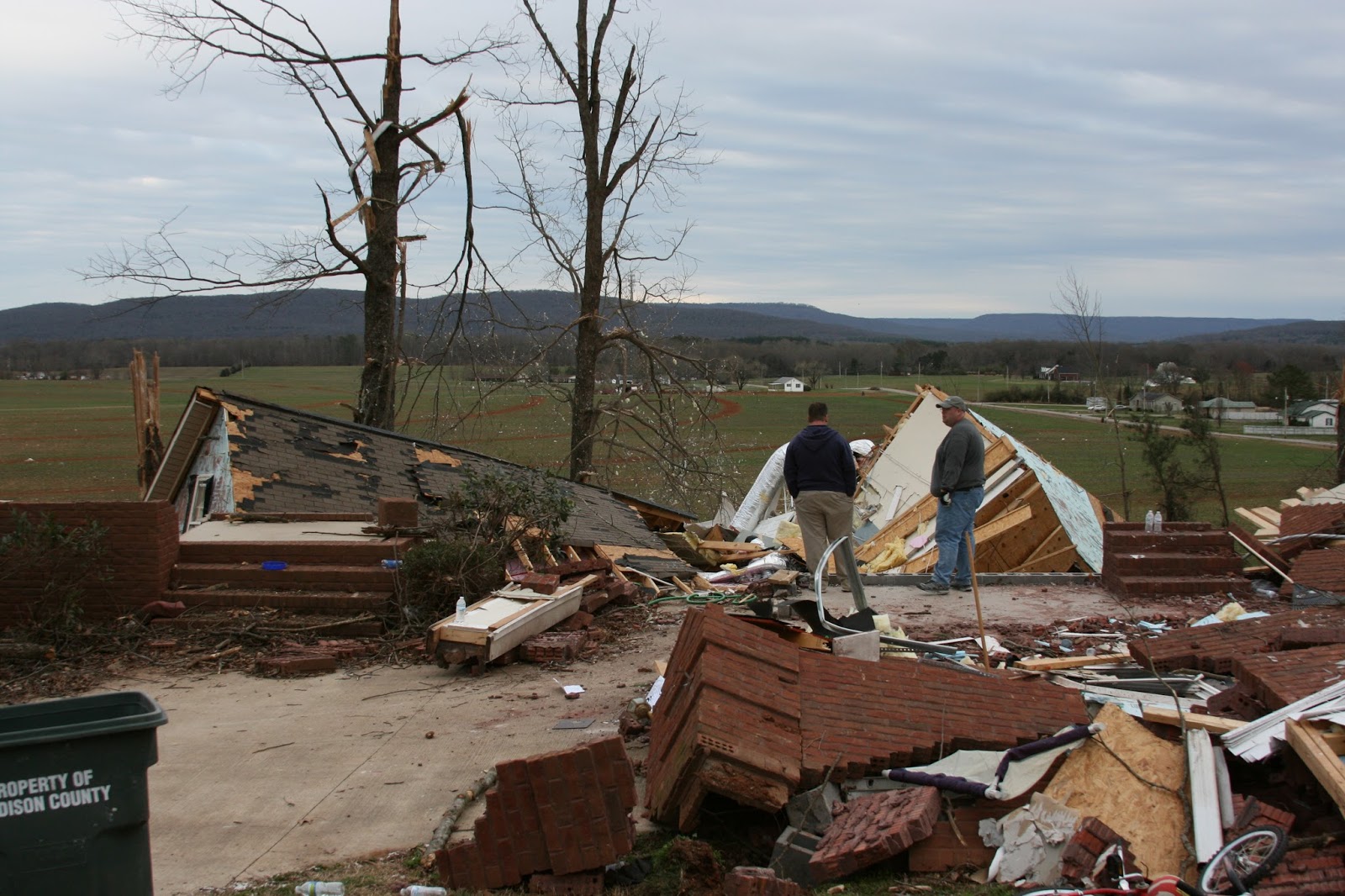
Standing over the rubble, I remember feeling strangely calm. Perhaps it was some level of shock, evidenced by the fact that in my report to my wife, I kept saying "the house was completely gone", creating a false picture. In fact, we salvaged a good deal more than I would ever have expected, looking at the destruction. But in a larger sense, I also knew that my Father in Heaven had a very tight hold on me right in that moment. For I knew, even in the moment, that it was just a house. My treasures, the people I love more than anyone in the world, were alive and safe. Ours was the only house in the neighborhood that was destroyed, and no one was home when it happened. Many of my neighbors were taking cover inside their homes when the tornado came through, and every one of them was safe. We had lost nothing that could not be replaced, and we would recover.
For the next week, it was a massive salvage operation. Slowly and steadily, we picked through every corner of the pile, pulling books, computers, files, and more. We found clothes and pictures, covered in drywall dust and insulation, but salvageable. We climbed through the collapsed kitchen to retrieve whatever wasn’t broken (excepting a memorable moment of fatalistic whimsy, in which my brother-in-law and I took turns hurling a set of old Corelle dishes down the hill like Frisbees). We rented storage units and filled them to the brim (in the end, even most of this would be hauled to the dump). We rented a house, and did everything possible to keep the boys in a normal routine (they did not miss any school). We were surrounded by people - family, friends from work, church, school, Scouts, and more, all of whom came alongside us in those first weeks. That memory, being the recipient of such great grace, is one memory I will always, always treasure. In fact, I want to be sure that if I hold on to anything, it is that experience of God's loving hand through the kindnesses of others.
That isn't to say it wasn't difficult or draining. Once we had picked through everything, it was time to clear the property. I remember well dealing with the emotional emptiness that people say so often follows traumatic experiences. Some days, it was very hard to soldier through. But we weren't really alone, no matter how we felt sometimes, and we did come through it.

I could go on, I suppose. But I am mindful that this was supposed to be a quick look back. With that, and knowing that I have chronicled our experiences with this storm and others before on this blog, and I suppose it would probably just be easier to point you, the reader, to these posts to read at your leisure. So let me list them here, after which I'll get on with my closing thoughts.
Yes, we lost much. But 5 years later, there is no question in my mind: we have gained more. The worst did not happen, and to compare our experience with those who have lost so much more than a house would be a grave disservice. To this day, I remain humbled by the grace and mercy that has been extended to me and my family by my Father in Heaven. And if ever I should fail to remember this, I merely have to walk outside and turn my eyes to the east, to the rising sun. I testify to this simple truth: if not for the storm, I would not have the view I have today - literally, and spiritually. His mercies are truly new, every morning.
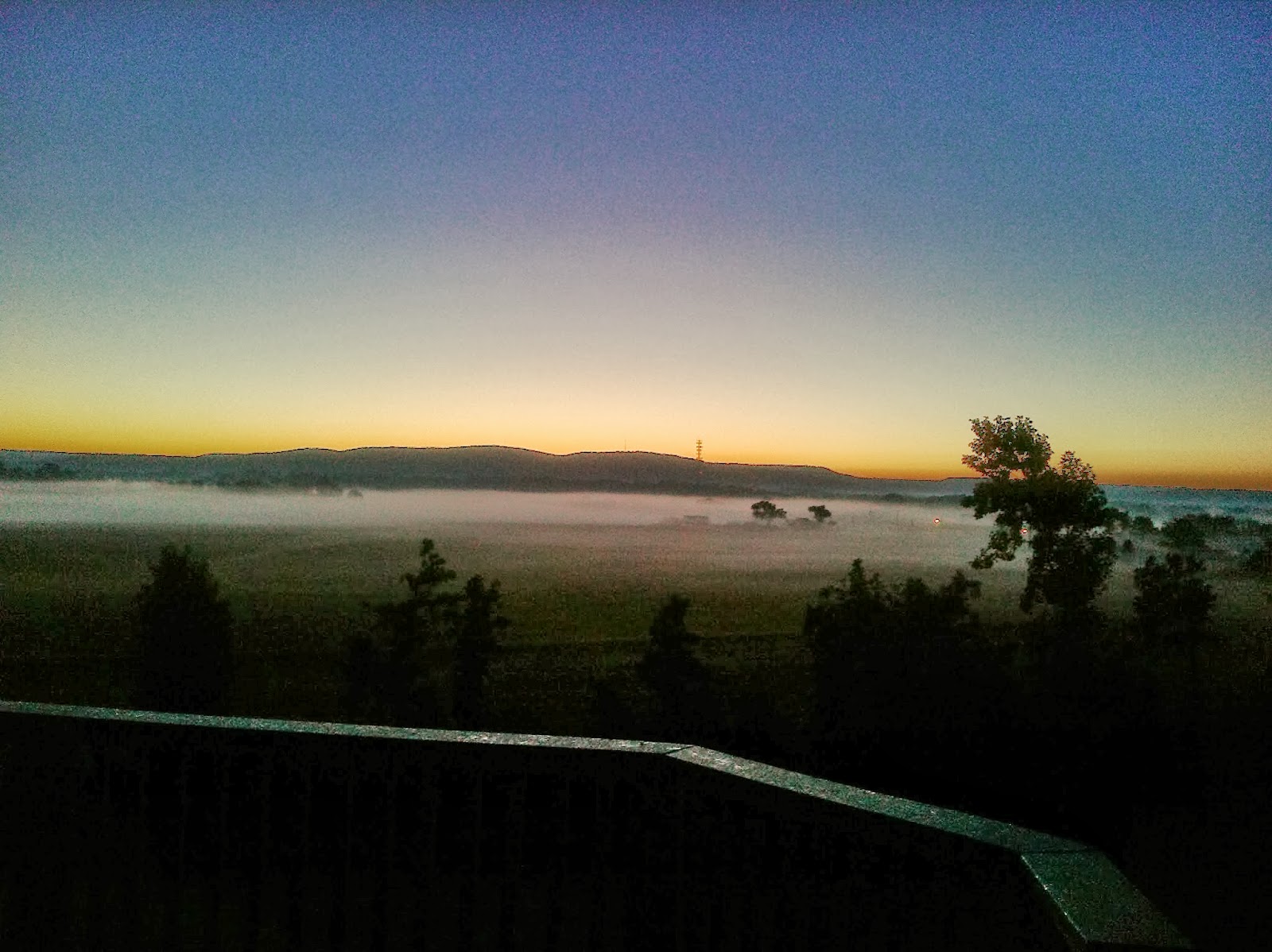


Five years. The more I dwell, the more I remember. But - and I cannot say this enough – I will (and must) be intentional about remembering the love and the grace we have received, and that we experience to this day. And most of all, I choose to look forward to the new day, where hope rises and affords the possibility of joy, of new life, of new dreams. For there is still more life ahead to be lived and to be embraced, whatever may come.
March 2, 2012. The day of our tornado.

Most of our community's collective memory centers around other storms. There was a horrific tornado in 1989. Then there is the woebegone neighborhood known as Anderson Hills, hit at least three times since 1995. And more recently, the major tornadic outbreak of April 27, 2011 that left hundreds across the state dead and all of us around here in the dark for a solid week. But the one usually not remembered is the one that hit too close to home. A direct hit, actually.
It was a Friday morning. The boys were at school, my wife and I at work at our respective employers. The day was very warm and muggy, somewhat unusual for an early March morning. There may have been a weather watch, of that I'm not sure. But there were a couple of storms about, and one cell in particular had my attention as I tracked it on internet radar. Various reports were coming in, and a phone call from my brother-in-law (who was on his way to work) confirmed that it looked pretty serious. It wasn’t long before a spotter reported a funnel cloud on the ground, and the projected track was taking the storm on a direct path to my neighborhood. I knew my immediate family was safely out of the way, but my in-laws live in the same area, and I found myself desperately praying that the cell would weaken or shift direction.
Suddenly, everything turned surreal. We have internet voice mail, and around 10:15, I got an email with a hurried, cryptic message from our next door neighbor: "… it got your house. Wait, are you there? Hello?" My first thought was simply that a tree had crashed through the house (we had a lot of trees). I called my wife, who had moments earlier gotten a text notification from our alarm system, an error indicating that the basement door had been opened. Our initial conclusion was that changes in air pressure caused the basement door to bulge and break the signal. At least, that is what we were hoping. Not knowing what to expect, but knowing that I needed to know, I left work and took off for home.
I don't remember what I was thinking on the drive home. There was another phone call from my brother-in-law, who was en route to the area. As I approached my neighborhood, a feeling of dread began to settle in. Dozens of trees were strewn across the road, and there was no immediate access to the area. I parked the car next to a block house (incidentally parking next to my brother-in-law), and ran up the hill into the war zone. Several of my neighbors were outside, already cleaning up, in shock, taking stock. Everyone seemed okay, for which I was very grateful. I asked one in particular how they fared, and the response was "Better than what happened in the cul-de-sac up there." My breath caught for a moment, but then I steeled myself and walked toward my street. I stopped at my in-laws, who were deeply shaken but okay. From there, I made my way to where my home once stood.
Standing over the rubble, I remember feeling strangely calm. Perhaps it was some level of shock, evidenced by the fact that in my report to my wife, I kept saying "the house was completely gone", creating a false picture. In fact, we salvaged a good deal more than I would ever have expected, looking at the destruction. But in a larger sense, I also knew that my Father in Heaven had a very tight hold on me right in that moment. For I knew, even in the moment, that it was just a house. My treasures, the people I love more than anyone in the world, were alive and safe. Ours was the only house in the neighborhood that was destroyed, and no one was home when it happened. Many of my neighbors were taking cover inside their homes when the tornado came through, and every one of them was safe. We had lost nothing that could not be replaced, and we would recover.
For the next week, it was a massive salvage operation. Slowly and steadily, we picked through every corner of the pile, pulling books, computers, files, and more. We found clothes and pictures, covered in drywall dust and insulation, but salvageable. We climbed through the collapsed kitchen to retrieve whatever wasn’t broken (excepting a memorable moment of fatalistic whimsy, in which my brother-in-law and I took turns hurling a set of old Corelle dishes down the hill like Frisbees). We rented storage units and filled them to the brim (in the end, even most of this would be hauled to the dump). We rented a house, and did everything possible to keep the boys in a normal routine (they did not miss any school). We were surrounded by people - family, friends from work, church, school, Scouts, and more, all of whom came alongside us in those first weeks. That memory, being the recipient of such great grace, is one memory I will always, always treasure. In fact, I want to be sure that if I hold on to anything, it is that experience of God's loving hand through the kindnesses of others.
That isn't to say it wasn't difficult or draining. Once we had picked through everything, it was time to clear the property. I remember well dealing with the emotional emptiness that people say so often follows traumatic experiences. Some days, it was very hard to soldier through. But we weren't really alone, no matter how we felt sometimes, and we did come through it.
I could go on, I suppose. But I am mindful that this was supposed to be a quick look back. With that, and knowing that I have chronicled our experiences with this storm and others before on this blog, and I suppose it would probably just be easier to point you, the reader, to these posts to read at your leisure. So let me list them here, after which I'll get on with my closing thoughts.
"When the Lights Can't Come Back On"There's more of course, just scan any of my posts March - August 2012. But moving on now, to the present. Nearly four years have passed since we moved into the rebuild. It was certainly disorienting at first, and even a year after moving in, it was weird. Today, I still catch myself looking in cabinets for things that we no longer have, or looking for them in places where they would have been in the old house, instead of where they are now. Fortunately, this is happening less often, but it still happens. It is the ultimate cliché, I know, but life really has moved on. The boys are older and thriving. We are older, working as hard as ever for our respective employers, going to church, and simply trying to keep up with the pace of life. I walk around the house and the yard, and as always, marvel at the number of projects still on my to-do list. The scars from the storm still mark our property, and to an extent our hearts. But they are healing, and they are not holding us back in any way.
"One Year Later, Or Last Month"
"The Future Remains Unwritten"
"One Year"
The Rebuild Process (Chase Manor 2.0)
Yes, we lost much. But 5 years later, there is no question in my mind: we have gained more. The worst did not happen, and to compare our experience with those who have lost so much more than a house would be a grave disservice. To this day, I remain humbled by the grace and mercy that has been extended to me and my family by my Father in Heaven. And if ever I should fail to remember this, I merely have to walk outside and turn my eyes to the east, to the rising sun. I testify to this simple truth: if not for the storm, I would not have the view I have today - literally, and spiritually. His mercies are truly new, every morning.
Five years. The more I dwell, the more I remember. But - and I cannot say this enough – I will (and must) be intentional about remembering the love and the grace we have received, and that we experience to this day. And most of all, I choose to look forward to the new day, where hope rises and affords the possibility of joy, of new life, of new dreams. For there is still more life ahead to be lived and to be embraced, whatever may come.
February 07, 2017
It's All Part of the Process

Quietly, the sun rises over the eastern horizon,I wrote the poem above almost 29 years ago, as a teenager feeling a little lost in the world. I have often observed that I have an old soul laced with melancholy, and looking back on those words I find it hard to deny. And here I am, all these years later, with a penchant for watching the sun rise over the hills and fields behind my house, feeling almost exactly the same way. I have so many wonderful blessings I can count: a loving, stable family, a nice home, a good church, and a job that while consuming enables me to take care of my family. We've had our share of troubles: loss of home, car accidents, health scares, but we've managed to do okay through it all. I really have absolutely nothing to complain about. I have been most fortunate.
The cold dark expanse advances and recedes
Along the mist covered sands.
Off in the distance
Seabirds cry out
As they begin their morning hunt.
The ocean breeze carries their sound to me,
And makes me shiver.
I stand there, alone in my thoughts
Trying to shake off the effects
Of another sleepless night,
Trying to capture that new,
Waking feeling that comes with
Each new day.
Trying, yet in vain,
For the feeling once again,
… eludes me.
And yet.
I watch the sun come up in all its glory, with a light breeze inviting the steam from my coffee to spiral away, and in the undeniably peaceful moment, I still find myself feeling a little lost in the world. I'm not certain where I'm headed, if in fact I am heading any particular direction. I've never been an overly driven person, and have only fleeting experiences with the kind of passion that motivates one to go beyond and immerse themselves into any particular thing. Hobbies? No, not really. Just haven't really found one that energizes me in any particular way.
None of this is uncommon to a man my age, I know this. Yet that knowledge does little to assuage the disorientation I feel at certain times. In Philippians 4:12-13, the Apostle Paul speaks of contentment, and the truth that such peace can be found in any circumstances through Jesus Christ. I've known contentment, even in some very hard circumstances. Being content, of course, is a state of the mind, a state of the heart. As such, that sense of contentment is subject to the meanderings of mood and the fickleness of feelings. But this idea of contentment has a cousin: the concept of fulfillment. Scriptures are a little less clear on the matter of fulfillment. But as illustrated by James 1:2-4, one can infer that fulfillment (becoming "mature and complete, lacking in nothing") is in fact a process. We all yearn to be "whole", and we are all at times very painfully aware that we are not. Oh sure, we get glimpses from that mountain top now and then, but it doesn't take much for that sense of incompleteness to reassert itself. I can only conclude that fulfillment, being a process, is an achievement that may be realized only after a lifelong pursuit. There will always be some part of me not yet complete, not quite whole - until the day comes when all things are completed, when all things are made whole.
The above can be summed up as simply as this: Contentment is a state; fulfillment is a process. The challenge: somehow being content within that process.
If any of this makes sense, and if any of it is true, where does that leave me? My coffee cup is empty, and the day still beckons. I still feel a little lost. I suppose I can rationalize it this way: it is okay to feel what I feel, because feelings are transitory and are a natural part of life. The key is to press on, remembering that fulfillment is possible. It just may take a while. And that allows me to be content in the hope that for those moments when I feel a little lost, they won't last. It's all a part of the process.
May 25, 2016
Bison's Eye
 Sometimes, you just have to get away. And not on some random airline. I'm talking about a good old fashioned, back of the station wagon kind of road trip. A good family vacation of this sort always produces stories that you can tell for years, or at least it should. Not wanting my kids to miss out on such an experience, last summer we loaded up the van and set forth on that utterly quintessential, cross-country family trip to the Grand Canyon. Holiday Road, anyone?
Long road trips are cathartic for me, especially if I'm driving. I am content to drive for hours in relative silence. While the occasional interlude of music or podcast isn't always unwelcome stimulation, I generally don't find it a necessity. Driving gives me time to process the perpetual jumble of thoughts inside my head. And this particular trip featured quite the collection of jumbled thoughts, as I was wrestling with the doubts not uncommon to a man in his mid-forties. Nothing dramatic, mind you, but the reevaluation of life's general trajectory at the proverbial half-way point seems to have become a frequent preoccupation of mine. After the first two days, I was feeling much better, much more settled in my spirit. But I digress.
The afternoon of the third day found us turning north on Hwy 89 from Flagstaff. The haze was heavy, muting the already earthen desert colors, but I was reveling in the alien landscape nonetheless. We came upon stretches of construction featuring one-lane alternating traffic that for the most part were tolerable, except for one where we found ourselves caught in a sudden, violent dust storm. I suppose there was a thunderstorm nearby, but we saw little rain from it. All traffic was stopped in both directions. As with any storm, sometimes you just have to wait it out until it passes. It always does.
From there, we swung over to 89A, filled up at Marble Canyon, rode along the base of the Vermillion Cliffs, and finally turned south on 67 across the Kaibab Plateau en route to the North Rim. The transformation of the landscape was startling, going from desert and haze to forest and blue sky in the late afternoon sun. Small meadows opened up on either side of the road. It was wonderfully picturesque, and my word don't do it justice. But my momentary reverie was about to be disrupted in a most startling way.
We were on approach to the small gatehouse marking the entrance to the North Rim, when I noticed a line of cars stopped in the opposing lane several hundred yards outside the park entrance. Further left, in an area of shallow meadow, was a herd of bison, about 30-head. That these people were stopped in the road alongside a herd of bison seemed to this traveler as not a wise thing to be doing. And then it happened.
As the gap closed between me and the line of paralyzed onlookers, from the herd came a beast, massive in size, with menace in his manner. He bounded along a path parallel to the road, and with a swiftness that defied his mass, turned toward us with head lowered, his visible eye wide and blazing. Like a movie cut in high definition clarity, slowed to half speed, I hit the brakes. Loose items suspended about me in mid-air, slave to Newton's equations, and slowly flew to the front of the cabin - GPS, phones, cups, snacks, and other various clutter that collects on a long cross-country family trip. But the van responded, nose dipped, and through a windshield that seemed much too close to my face, I watched as the beast passed mere meters in front of me, such that I could see the powerful flank rippling and glistening with sweat. And above all, the eye of my adversary glowering with an unveiled hostility. And then he was across the road, to my right. To my left, the standing line of onlookers, still not moving, jaws dropped in almost witless expressions and still clearly unaware of their imminent danger. As for me, I shifted my foot immediately from the brake to the accelerator, gently but deliberately leaving the scene lest the creature decide to take another shot at this mechanical beast that so threatened his herd. And in those moments after, as the passage of time returned to normal, as my pulse slowed and the nerve endings along my spine ceased to tingle, I could only express: Did that just happen? Did that really just happen? Even now, I can still remember with perfect clarity my close encounter with that thunderous beast. And his defiant, unforgiving eye.
In the year since these events, I have pondered and probed this experience for some deeper meaning, a way to turn what is merely a fun and thrilling tale into some sort of metaphor or allegory that illuminates some portion of this absurd existence. Alas, I have nothing. Nothing that isn't already painfully, ridiculously obvious. News flash: Bison are not tame, they are not cattle. They are fierce, powerful beasts that are highly protective of their herd, and will not shy from attacking anything or anyone they perceive to be a threat.
I have only this: A bison charging across the road always has the right of way. Always.
Words to live by, don't you think?
March 30, 2016
Thoughts in the Aftermath of a Silly Online Quiz
Some months ago, in a moment of weakness, I succumbed to the most frivolous of digital temptations: a silly online "quiz." No, this was not some examination designed to test my knowledge of world geography, or to measure my understanding of obscure facts in the Star Wars universe. Rather, this quiz purported to reveal secrets about the nature of my personality based solely on - wait for it - what shapes most appeal to me. I've seen different versions of this from various team building seminars, but this particular one appeared to be even less scientific (if that is possible). There were some 20 questions, almost all of which asked me to select an image from a group that most appealed to me. I know you are anxiously awaiting the big reveal, so here it is (in part):
Silly online quiz … probably exists only to collect personal data in some way to further enhance or exploit my "digital footprint" to the benefit of somebody else, or to sell me hiking boots.
But I must admit, these results have made me think. My 45th birthday is mere months away, and I have been pondering what to do differently, if anything, with the second half of my life. I've considered going back to school for a Master's degree, as well as the possibility of a career change, but have come to the initial conclusion that right now, I have neither the funds nor the guts to pursue either. In the near term, I'll probably have to settle for picking up a new hobby. Writing online quizzes, for example.
I do wish, sometimes, that I was that Explorer. I was as a child, at least in my imagination. Those days are mostly gone now. But the idea still flickers, deep down, I think, for whenever I give in to this navel-gazing introspection, a snippet of an old John Denver song plays in my mind:
Or maybe it just means I like rectangles.
You are most often drawn to shapes that include rectangles, and this makes you the Explorer. You seek adventure and new experiences, and yet sometimes lack the funds or guts to make it happen. You are inquisitive by nature, and courageous too. You are naturally supportive of your loved ones and have tremendous strength and foresight. For those of you that take the risk, and go forth and travel, you love to get to know other cultures and people on your journeys. Explorers have a passion for knowledge, and like to converse with people from all walks of life. You seek harmony and balance in your endeavors, and thrive most when you are able to juggle risk and reward to your benefit. Curious, dependable, determined, and spirited, that is you.Ah, behold the revelation of my true self, exposed by the selection of images that contain rectangles, above those with squares, circles, triangles, and abstract mishmashes of shapeless colors. Look at me, the Explorer! I am sure that when people see me, or think of me, "Explorer" is naturally the very first thing that comes to mind. Yeah.
Silly online quiz … probably exists only to collect personal data in some way to further enhance or exploit my "digital footprint" to the benefit of somebody else, or to sell me hiking boots.
But I must admit, these results have made me think. My 45th birthday is mere months away, and I have been pondering what to do differently, if anything, with the second half of my life. I've considered going back to school for a Master's degree, as well as the possibility of a career change, but have come to the initial conclusion that right now, I have neither the funds nor the guts to pursue either. In the near term, I'll probably have to settle for picking up a new hobby. Writing online quizzes, for example.
I do wish, sometimes, that I was that Explorer. I was as a child, at least in my imagination. Those days are mostly gone now. But the idea still flickers, deep down, I think, for whenever I give in to this navel-gazing introspection, a snippet of an old John Denver song plays in my mind:
Come dance with the west wind and touch on the mountain tops.I suppose, this is one facet of being an Explorer: reaching for Heaven, hoping for the Future, and looking toward all that we can be, and not just what we are today. I cannot begin to explain how this one verse in an old song speaks to me. Maybe, just maybe, it is confirming that long buried idea that I really can be more like this Explorer character.
Sail o'er the canyons and up to the stars.
And reach for the heavens and hope for the future
and all that we can be, and not what we are.
Or maybe it just means I like rectangles.
March 25, 2016
Review: The Killing of History
 For the past many decades, even the casual observer cannot help but to see that any activity, approach, or viewpoint that takes on (or has forced upon it) the descriptor of "traditional" is increasingly portrayed in a negative light. The arguments over traditional vs. contemporary (modernism, postmodernism, relativism) play out in almost every venue imaginable, most notably in academia, religion, and politics. Keith Windschuttle's The Killing of History: How Literary Critics and Social Theorists are Murdering Our Past pulls back the curtain on one such pitched battle in the field of historical studies. For the layman who may be largely unexposed to the various positions, theories, and methodologies at play, this book is a difficult read, and will take additional effort and self-directed research to properly interpret and absorb. While Mr. Windschuttle does offer definition, description, and context in his presentation of the issues that form the basis of the argument, what is offered presumes a certain level of preexisting knowledge of the subject matter and the debate.
 From the opening pages of Mr. Windschuttle's treatise, it quickly becomes apparent that his work is not so much an intent to introduce the layman to the ongoing philosophical battles surrounding the study of history and its methods, but rather it is in fact a series of salvos directed at proponents of more contemporary theories on the discipline. The layman is unlikely to be familiar with the works of Derrida, Foucault, and a host of other historical theorists, past and present, and so to a certain extent has to trust the author's presentation of their cases and viewpoints. Nevertheless, the reading is a worthwhile exercise, because in doing so one acquires a better understanding of the motivations and the deficiencies behind the movements and initiatives that do reach the public eye, particularly as it pertains to history curriculum in schools, the phenomenon of "cultural studies" as a substitute for the more traditional views identified with Western civilization, and so forth.
As one reads the final chapter and closes the book, the reader cannot help but to sense that an important opportunity has been missed. For while Mr. Windschuttle's aim is to expose as illogical and unsupportable the theories of history that cannot be supported by empirical evidence, his defense of traditional methods of historical study is often limited to the contrast he presents against the ideas and theories he opposes. In other words, he fails to make a strong final case in favor of the traditional model of historical study. This is unfortunate, because he has a case to make. The reader would have been better served if the author had provided a conclusive retrospective that summarized the supremacy of his preferred methodology, instead of a two or three paragraph write-off to close the work. As a result, one is left with the impression that the book is more of a broadside against the ideas he opposes, and less a defense of the ideas for which he advocates. There is fantastic research here, and worth additional study. But it could have been more.
March 01, 2016
I Will Vote for Whomever I Please, Thank You
Ah, election season. A time for advocates of all stripes to proclaim to one and all why their candidate is the best, last hope in saving this great nation. A time for desperate pleas to join the cause, to stay loyal to the movement, to place my trust in the one who pledges to “take on Washington” and all its corruption. A time to bet on the horses, because really, all that matters is winning, about keeping the lesser beasts from ruining our country.
Advocates are passionate for their preferred candidates, and so they should be. I can stomach most arguments on behalf of any candidate, because such arguments all take on the same form, once you step back and examine them. For any given candidate, the advocate lauds notable characteristics and policy positions while simultaneously dismissing any flaws, all the while augmenting the flaws and downplaying any notable characteristics or positions of another candidate. More simply, it is the parable of the beam and the mote. The politics of destruction is powerful temptation, even among members of the same “team.” Again, this is the established pattern, and by and large I can entertain such arguments, and on occasion even be entertained by them.
What I cannot stomach, however, is the following argument that I see thrown out from time to time, even from friends: “A Vote for Candidate A is really a Vote for Candidate F.” I find such approaches to be unpersuasive at best, insulting at worst. I find it to be both the weakest and most desperate of arguments, logically and factually incorrect on its face.
With every choice, there are consequences. When I cast my vote, I may pick a loser, but in no way can you logically extrapolate that unfortunate result into a plus for the winner. It may seem a “waste” to supporters of another candidate, and they are entitled to that view. Nevertheless, my ballot will lie in the stack of whomever I choose, and only in his stack.
I have the fortunate privilege and responsibility to vote, and I take it seriously. I will vote for the candidate that best fits my view and my values. Absent such a candidate, I reserve the right to make a third choice and not cast a vote for that office. This is a choice I make, and that choice is an extension of what I believe and what I think. No more, no less. I don’t make such choices lightly, and I will never in good conscience vote for any candidate that I don’t consider as sufficiently worthy of my vote. Results may vary, but by and large I hold this to be true. Rest assured, I would no more vote for a tyrant than I would vote for a criminal.
I hold allegiance only to God and Country, not to party, not to any interests but those that align to my views and my values. It is my right, my freedom, my integrity, and my decision.
So, please, spare me such a specious argument as “A Vote for A is really a Vote for F“. I will vote for whomever I please, and if in the end my vote doesn’t matter, or doesn’t make anyone else happy, so be it. But nevertheless, my vote will count, and I will gladly stand to be counted, win or lose.
Advocates are passionate for their preferred candidates, and so they should be. I can stomach most arguments on behalf of any candidate, because such arguments all take on the same form, once you step back and examine them. For any given candidate, the advocate lauds notable characteristics and policy positions while simultaneously dismissing any flaws, all the while augmenting the flaws and downplaying any notable characteristics or positions of another candidate. More simply, it is the parable of the beam and the mote. The politics of destruction is powerful temptation, even among members of the same “team.” Again, this is the established pattern, and by and large I can entertain such arguments, and on occasion even be entertained by them.
What I cannot stomach, however, is the following argument that I see thrown out from time to time, even from friends: “A Vote for Candidate A is really a Vote for Candidate F.” I find such approaches to be unpersuasive at best, insulting at worst. I find it to be both the weakest and most desperate of arguments, logically and factually incorrect on its face.
With every choice, there are consequences. When I cast my vote, I may pick a loser, but in no way can you logically extrapolate that unfortunate result into a plus for the winner. It may seem a “waste” to supporters of another candidate, and they are entitled to that view. Nevertheless, my ballot will lie in the stack of whomever I choose, and only in his stack.
I have the fortunate privilege and responsibility to vote, and I take it seriously. I will vote for the candidate that best fits my view and my values. Absent such a candidate, I reserve the right to make a third choice and not cast a vote for that office. This is a choice I make, and that choice is an extension of what I believe and what I think. No more, no less. I don’t make such choices lightly, and I will never in good conscience vote for any candidate that I don’t consider as sufficiently worthy of my vote. Results may vary, but by and large I hold this to be true. Rest assured, I would no more vote for a tyrant than I would vote for a criminal.
I hold allegiance only to God and Country, not to party, not to any interests but those that align to my views and my values. It is my right, my freedom, my integrity, and my decision.
So, please, spare me such a specious argument as “A Vote for A is really a Vote for F“. I will vote for whomever I please, and if in the end my vote doesn’t matter, or doesn’t make anyone else happy, so be it. But nevertheless, my vote will count, and I will gladly stand to be counted, win or lose.
December 12, 2015
The Great White-Out of Midway High
What you are about to read is true. Well, as true as the passage of 30 years will allow, given that time tends to muddy the recollection. Still, the story I am about to share remains a fixed part of my personal oral history, embellished only where necessary to enhance the tale and its telling.
In the vast flatness spanning the horizon west of Grand Forks, one will find dozens of small, largely unincorporated communities with names like Mekinock, Gilby, Inkster, Johnstown, Honeyford, and Forest River. The first of these, where I lived for a time, rested 5 miles north of the runways of Grand Forks AFB, where on any given day B-52 heavies would fly directly overhead, mere hundreds of feet overhead, on their way to who knows where. Some of those flights featured crews that included my dad, but I digress.
On a lonely county road, in the relative center of all these townships, is Midway Public School. In my day, Midway was a K-12 facility, with only enough students to fill a single class for each grade. Indeed, had I stayed there through all of my high school years, I would have been in a graduation class of about 29. If I had to guess, I’d wager that this remains more or less the case to this day. The school features a hexagon pod for 1st-6th, and a couple of hallways for grades 7-12. We had a gym, of course, a real “shop” for woodworking, welding, and the like, and a big, curtained stage (part of the gym) where the pep band would stand and play for basketball games. From my home, the bus ride to and from school was 30 minutes – and I was the last pickup in the morning, and the first drop off in the afternoon. In my mind’s eye, I can still see it all – the gravel roads, the grain elevators, the unending flatness of the fields – as if it were yesterday.
Winters in this part of the country are marked by three things: frigid cold, bitter, howling wind, and drifts upon drifts of snow. Weather systems often drop out of Canada with frightening speed, bringing subzero temps, winds 40-50 miles per hour and even more, inches upon inches of snow, and drifts several feet high across the roads. This is a tale of one such storm.
I was sitting in class late one afternoon, English class I think, listening to the teacher drone on about something I don’t recall. To my left was a bank of windows that looked out to the parking lot in front of the school. It was an overcast day, but not unpleasant as far as that goes. As the clock turned slowly on its dial, it began to get darker, but there wasn’t anything unusual about that at that time of day, that time of year. Snow began to fall, and the wind started picking up, but again, nothing out of the ordinary for the northern Dakota plains.
Then it hit – a wall of wind and snow that shook the windows so hard that even the teacher was momentarily startled out of her monologue. We all stared at the window, chattering and marveling at what we were seeing. Or rather, not seeing. For where moments before you could see cars a mere 10-15 yards away, now was a wall of white. We’d had such conditions before, but usually they were relatively short-lived, and often looked worse than they really were (a good wind on a bright sunny day can grab the snow and blow it against the windows, creating a similar effect). This time, however, we were dealing with the real thing.
It wasn’t long before the principal came on the PA, announcing to the school that busing was being suspended due to the increasingly hazardous conditions. What with the wind and zero visibility, that was kind of a no-brainer. Students were to go on to their last period classes and wait for further instructions. The bell rang, and we went on, but with the buzz of adrenaline and excitement that comes with the knowledge that we were in the middle of something quite outside our normal routine.
By 3:00, the wind and the snow had only gotten worse. Some brave parents (or stupid, as the case may be) ventured out to the school to pick up their kids. But the vast majority of students like myself, dependent on the buses, were stuck. The principal came on the PA again, to announce that due to the worsening conditions of the storm, all students and teachers were to proceed back to their 1st period classes, where we were to in effect start a “new day” of school, regular schedule. Attendance would be taken. “Lunch” would in fact hit right about dinner time.
And so we did. Most teachers turned their class periods into a study hall of sorts, allowing us to complete the assigned homework from earlier in the day. One or two of mine continued with the next day’s lesson plan. Actually, it was quite ingenious, because it kept us busy (and contained) for as long as possible. Outside, darkness fell, the wind howled, and the white-out continued. Dinner consisted of grilled cheese, some kind of soup, and that chocolate cake mix the kitchen staff insisted was “pudding”. By the end of our second rotation through the school day, it was clear that we were headed into uncharted territory: they were keeping us overnight.
And then the party started. The gym was opened up, initially half-court for volleyball, half-court for basketball. Later, the volleyball nets were pushed to the side, to accommodate even more basketball. The pick-up games went on all night – and I do mean all night. Some classrooms that had AV equipment (TV/VCR on rolling carts) had movies, but I don’t recall too many showing much interest in that. One room had a computer, a TRS-80 maybe, that had one popular, hand-jammed BASIC game: Mow the Lawn. A few others may have worked on projects in the shop. But most of us wandered around, doing a little bit of everything, making the most of the freedom that came with having the run of the school. Teachers tried to chaperone, of course, but on the whole, given that there were fewer than 200 of us at most, things didn’t get too bad. The parents need not have worried about those poor kids stuck overnight at school; hanging out all night with friends, making the most of what was probably a bad situation, we were having a ball. A few people eventually did try to find quiet corners to sleep, but truth be told, not many of us really tried. At one point during the night, a couple of us went down the hall to the elementary pod to check on siblings. Most of these young ones had curled up to sleep in various places on the floor. I have no idea what else these teachers did to keep order down there, but I am certain they had their hands full.
By 2 a.m., the storm had finally passed, even clearing enough to allow the brilliant white moon to be seen shining overhead. Word got around that buses would roll at 7 a.m., as soon as the plows had cleared the worst off the roads. School was off the next day, of course. Sure enough, the sun came up on another frigidly cold morning. We loaded the buses and made our way home. And promptly went to bed. Well, at least I did.
Having lived in the South since the summer of ’86, I’ve seen what passes for winter weather here. Some years feature actual snowfall, a bit of ice, and the general disruption of life in a place ill-equipped to handle such things. And each time winter pays us a visit, I cannot help but to recall, retell, and romanticize the story I’ve come to call “The Great White-Out of Midway High”. For the better part of 24 hours, it was winter at its worst, but through the eyes of youth – the time of our lives, and a memory for a lifetime.
In the vast flatness spanning the horizon west of Grand Forks, one will find dozens of small, largely unincorporated communities with names like Mekinock, Gilby, Inkster, Johnstown, Honeyford, and Forest River. The first of these, where I lived for a time, rested 5 miles north of the runways of Grand Forks AFB, where on any given day B-52 heavies would fly directly overhead, mere hundreds of feet overhead, on their way to who knows where. Some of those flights featured crews that included my dad, but I digress.
On a lonely county road, in the relative center of all these townships, is Midway Public School. In my day, Midway was a K-12 facility, with only enough students to fill a single class for each grade. Indeed, had I stayed there through all of my high school years, I would have been in a graduation class of about 29. If I had to guess, I’d wager that this remains more or less the case to this day. The school features a hexagon pod for 1st-6th, and a couple of hallways for grades 7-12. We had a gym, of course, a real “shop” for woodworking, welding, and the like, and a big, curtained stage (part of the gym) where the pep band would stand and play for basketball games. From my home, the bus ride to and from school was 30 minutes – and I was the last pickup in the morning, and the first drop off in the afternoon. In my mind’s eye, I can still see it all – the gravel roads, the grain elevators, the unending flatness of the fields – as if it were yesterday.
Winters in this part of the country are marked by three things: frigid cold, bitter, howling wind, and drifts upon drifts of snow. Weather systems often drop out of Canada with frightening speed, bringing subzero temps, winds 40-50 miles per hour and even more, inches upon inches of snow, and drifts several feet high across the roads. This is a tale of one such storm.
I was sitting in class late one afternoon, English class I think, listening to the teacher drone on about something I don’t recall. To my left was a bank of windows that looked out to the parking lot in front of the school. It was an overcast day, but not unpleasant as far as that goes. As the clock turned slowly on its dial, it began to get darker, but there wasn’t anything unusual about that at that time of day, that time of year. Snow began to fall, and the wind started picking up, but again, nothing out of the ordinary for the northern Dakota plains.
Then it hit – a wall of wind and snow that shook the windows so hard that even the teacher was momentarily startled out of her monologue. We all stared at the window, chattering and marveling at what we were seeing. Or rather, not seeing. For where moments before you could see cars a mere 10-15 yards away, now was a wall of white. We’d had such conditions before, but usually they were relatively short-lived, and often looked worse than they really were (a good wind on a bright sunny day can grab the snow and blow it against the windows, creating a similar effect). This time, however, we were dealing with the real thing.
It wasn’t long before the principal came on the PA, announcing to the school that busing was being suspended due to the increasingly hazardous conditions. What with the wind and zero visibility, that was kind of a no-brainer. Students were to go on to their last period classes and wait for further instructions. The bell rang, and we went on, but with the buzz of adrenaline and excitement that comes with the knowledge that we were in the middle of something quite outside our normal routine.
By 3:00, the wind and the snow had only gotten worse. Some brave parents (or stupid, as the case may be) ventured out to the school to pick up their kids. But the vast majority of students like myself, dependent on the buses, were stuck. The principal came on the PA again, to announce that due to the worsening conditions of the storm, all students and teachers were to proceed back to their 1st period classes, where we were to in effect start a “new day” of school, regular schedule. Attendance would be taken. “Lunch” would in fact hit right about dinner time.
And so we did. Most teachers turned their class periods into a study hall of sorts, allowing us to complete the assigned homework from earlier in the day. One or two of mine continued with the next day’s lesson plan. Actually, it was quite ingenious, because it kept us busy (and contained) for as long as possible. Outside, darkness fell, the wind howled, and the white-out continued. Dinner consisted of grilled cheese, some kind of soup, and that chocolate cake mix the kitchen staff insisted was “pudding”. By the end of our second rotation through the school day, it was clear that we were headed into uncharted territory: they were keeping us overnight.
And then the party started. The gym was opened up, initially half-court for volleyball, half-court for basketball. Later, the volleyball nets were pushed to the side, to accommodate even more basketball. The pick-up games went on all night – and I do mean all night. Some classrooms that had AV equipment (TV/VCR on rolling carts) had movies, but I don’t recall too many showing much interest in that. One room had a computer, a TRS-80 maybe, that had one popular, hand-jammed BASIC game: Mow the Lawn. A few others may have worked on projects in the shop. But most of us wandered around, doing a little bit of everything, making the most of the freedom that came with having the run of the school. Teachers tried to chaperone, of course, but on the whole, given that there were fewer than 200 of us at most, things didn’t get too bad. The parents need not have worried about those poor kids stuck overnight at school; hanging out all night with friends, making the most of what was probably a bad situation, we were having a ball. A few people eventually did try to find quiet corners to sleep, but truth be told, not many of us really tried. At one point during the night, a couple of us went down the hall to the elementary pod to check on siblings. Most of these young ones had curled up to sleep in various places on the floor. I have no idea what else these teachers did to keep order down there, but I am certain they had their hands full.
By 2 a.m., the storm had finally passed, even clearing enough to allow the brilliant white moon to be seen shining overhead. Word got around that buses would roll at 7 a.m., as soon as the plows had cleared the worst off the roads. School was off the next day, of course. Sure enough, the sun came up on another frigidly cold morning. We loaded the buses and made our way home. And promptly went to bed. Well, at least I did.
Having lived in the South since the summer of ’86, I’ve seen what passes for winter weather here. Some years feature actual snowfall, a bit of ice, and the general disruption of life in a place ill-equipped to handle such things. And each time winter pays us a visit, I cannot help but to recall, retell, and romanticize the story I’ve come to call “The Great White-Out of Midway High”. For the better part of 24 hours, it was winter at its worst, but through the eyes of youth – the time of our lives, and a memory for a lifetime.
September 08, 2015
It's September, and that Means Sunrises
Of course, the sun rises everyday. And yes, the approach of dawn can be beautiful any time of year, if the conditions are just right. For the past few years however, it seems that September is the prime month for the kind of sunrises that reach beyond the barriers I so carefully erect, filling my eyes with colors and sometimes tears. I age with the seasons, and perhaps it truly is for such a time as this, when my reserves are low and I ache for renewal, that these masterpieces of divine tapestry arrive in quiet splendor.
His mercies are indeed new every morning.

His mercies are indeed new every morning.

August 07, 2015
Random MishMash
I'm not writing much these days, as should be quite apparent by now. There are many reasons for this, many having to do with the notion that "discretion is the better part of valor," which to take the true Shakespearean meaning serves as an indictment against the type of man I think I claim to be. I could say I am busy, which would also be true, but even this does not tell the whole story. I could say I am concerned with the Orwellian trends in our discourse, and that some exercise of caution may be warranted, particularly with respect to future employment given the public nature of our social media, blogs, and the like.
Needless to say, I've been doing some soul searching as to what I should be writing about, what I want to write about, and whether there is much to be gained by writing at all. (Hey, if I'm going to have a crisis of faith, better that it involves something like this than anything else more important!)
Below are a couple of nuggets, bite-size rants if you will, that are standalone thoughts I've jotted down or copied off over the last month or so, but never developed into anything more meaningful. They are generally devoid of context, so I'll leave it to your imagination what drove me to put them down.
Key quotes:
And finally:
I also have a story about a bison, that perhaps one day I will put to print. I've started the composition several times, but end up marveling at the idea that perhaps I am more like the bison than I would have ever imagined. When I get that figured out, I'll have a story worth telling.
Needless to say, I've been doing some soul searching as to what I should be writing about, what I want to write about, and whether there is much to be gained by writing at all. (Hey, if I'm going to have a crisis of faith, better that it involves something like this than anything else more important!)
Below are a couple of nuggets, bite-size rants if you will, that are standalone thoughts I've jotted down or copied off over the last month or so, but never developed into anything more meaningful. They are generally devoid of context, so I'll leave it to your imagination what drove me to put them down.
- I am forever amazed at those who believe progress means nullifying history rather than learning from it, and each other. And yet I shouldn't be, for this is a tale as old as civilization itself.
- Willful blindness and the inability to accept the humanity and fallibility of our forebears for what they are makes my head explode.
Key quotes:
"Everything is permissible"--but not everything is beneficial. "Everything is permissible"--but not everything is constructive. - 1 Corinthians 10:23
“For under the smooth legal surface of our society there are already moving very lawless things. We are always near the breaking-point when we care only for what is legal and nothing for what is lawful. Unless we have a moral principle about such delicate matters as marriage and murder, the whole world will become a welter of exceptions with no rules. There will be so many hard cases that everything will go soft.”- G. K. Chesterton
And finally:
- If a fool happens to speak the truth, that a fool said it makes it no less the truth.
- Truth is more about what is, and less about what you think it is, or even who said it. Objective truth matters.
I also have a story about a bison, that perhaps one day I will put to print. I've started the composition several times, but end up marveling at the idea that perhaps I am more like the bison than I would have ever imagined. When I get that figured out, I'll have a story worth telling.
June 06, 2015
A Dad's Lament
Later this week, my boys are finally going to learn to fish, and I'm not going to be there. Someone else will be teaching them, and that depresses me.
Some of my fondest childhood memories hail back to a time when the highlight of the summer was a week-long fishing trip to a lake in the woods of northern Minnesota, where the target catch was walleye, Northern Pike, and the occasional perch. Learning at the feet of my grandfather, my father, and my uncle all the while competing with my cousins as to who could catch the most fish, these hold a special significance for me. Of course, if I am honest, many days were spent just hoping to catch anything at all. Nevertheless, the lessons in tying fishing line, setting the hook, getting out of the weeds, casting without hooking anyone in the process, cleaning a fish … all these foundational experiences set forth in me a life-long love for being on the water, with a line in, passing the time.
And then, the sad resignation that since one trip in college, I haven't been fishing in 20 years.
As Boy Scouts, my sons are heading to camp, where each will work to earn their Fishing Merit Badge. Yesterday, I bought each of them new gear, including rod and reel, to replace those that I had once owned but was unable to recover from the storm.
Today, I taught them what a swivel barrel is, and how to tie the line to the swivel. I showed them what the different lures were for, the difference between a jig and a spinner, and how to attach a bobber. I showed them proper casting technique, taking advantage of the yard's tall grass to simulate the effect of having the lure get caught in the weeds, and how to gently but firmly tug at it without breaking the line.
I then went inside, while they continued to practice off the back deck.
I know there is still time, but the fact is there is not nearly enough of it. My oldest will be off to college in just a couple of years. They will have a different set of memories and experiences than I had growing up, and I suppose that is okay. But my heart hurts that I have not managed to make this one thing that was so important to me a part of their experience.
My boys might catch a fish this week. And if they do, I won't be there to see it, or to share in their joy.
The thought of this makes me ache, far more than I care to admit.
But I still hope they catch the fish.

Some of my fondest childhood memories hail back to a time when the highlight of the summer was a week-long fishing trip to a lake in the woods of northern Minnesota, where the target catch was walleye, Northern Pike, and the occasional perch. Learning at the feet of my grandfather, my father, and my uncle all the while competing with my cousins as to who could catch the most fish, these hold a special significance for me. Of course, if I am honest, many days were spent just hoping to catch anything at all. Nevertheless, the lessons in tying fishing line, setting the hook, getting out of the weeds, casting without hooking anyone in the process, cleaning a fish … all these foundational experiences set forth in me a life-long love for being on the water, with a line in, passing the time.
And then, the sad resignation that since one trip in college, I haven't been fishing in 20 years.
As Boy Scouts, my sons are heading to camp, where each will work to earn their Fishing Merit Badge. Yesterday, I bought each of them new gear, including rod and reel, to replace those that I had once owned but was unable to recover from the storm.
Today, I taught them what a swivel barrel is, and how to tie the line to the swivel. I showed them what the different lures were for, the difference between a jig and a spinner, and how to attach a bobber. I showed them proper casting technique, taking advantage of the yard's tall grass to simulate the effect of having the lure get caught in the weeds, and how to gently but firmly tug at it without breaking the line.
I then went inside, while they continued to practice off the back deck.
I know there is still time, but the fact is there is not nearly enough of it. My oldest will be off to college in just a couple of years. They will have a different set of memories and experiences than I had growing up, and I suppose that is okay. But my heart hurts that I have not managed to make this one thing that was so important to me a part of their experience.
My boys might catch a fish this week. And if they do, I won't be there to see it, or to share in their joy.
The thought of this makes me ache, far more than I care to admit.
But I still hope they catch the fish.

April 17, 2015
Star Wars Reboot - Yeah, I'm Ready
Ok, what follows is really my brother's domain, but man, I cannot help but to get a little excited about this. Unlike so many others, apparently, I'm a pretty big fan of J.J. Abrams, from his work on Lost as well as the Star Trek reboots. (Some of that, mind you, has much to do with the regular involvement of composer Michael Giacchino for the soundtracks).
Nevertheless, I have high hopes for the new Star Wars coming out in December:
It'll be weird dealing with the new faces, but after further review, that might be a good thing. I mean, Harrison Ford! Indiana Jones once said it wasn't the age, it was the mileage. If that's the case, then geez, the parsecs on that guy!
Nevertheless, I have high hopes for the new Star Wars coming out in December:
It'll be weird dealing with the new faces, but after further review, that might be a good thing. I mean, Harrison Ford! Indiana Jones once said it wasn't the age, it was the mileage. If that's the case, then geez, the parsecs on that guy!
February 26, 2015
Southern Snow
Snowfall in Alabama is rarely a news-driving event, but every now and then, Mother Nature pops in to remind us that with weather, anything can happen. Beginning late yesterday afternoon and continuing late into the evening, she unloaded 8 plus inches of snow across the Tennessee Valley. Here at the house, we managed "only" 5 inches or so. Enough to play in, enough to sled upon, but not enough to survive today's 40-degree high.
So last night and this morning, we took advantage of the gift we receive all too rarely around here. You should be able to click an image below to enlarge.


So last night and this morning, we took advantage of the gift we receive all too rarely around here. You should be able to click an image below to enlarge.


February 05, 2015
Escaping with Copland
Once in a while, I need a little escape, a means of tuning out and tuning in. Sometimes I turn to books, other times I'll binge watch television. I tend to stay away from video games, due to a certain addictive weakness I've had since I was a kid (even moderation is tough for me on this one, all these years later). Of course, in the office, the opportunity to escape is nearly impossible without just giving up and taking a personal day. Be that as it may, on a day like today, I'm turning to music. In particular, Copland. Of course, the risk is that I get lost in the music and lose all semblance of productivity. But sometimes, you just have to. Today is one of those days.
So Copland it is.
So Copland it is.
January 09, 2015
What Is E-Walker's Parade?
Well, here it is 2015. The headlines are divers and depressing, and I have an opinion about most of them, but nary the will to write about any of them. It has been that way for most of 2014, and from this point in January, I don't see much changing in that regard. This alone explains the big decline in posting frequency on this blog.
I'm not entirely sure what that means for the future, but I do know enough to know that I am not ready to give up on writing, and subsequently, I'm not ready to give up on this blog. So to kick off the new year, perhaps it is time for an origin story.
I find it mildly interesting that in the five years I've been blogging, no one has ever actually asked me to explain the story behind the title and tagline of my blog. It is especially interesting given that I am an Auburn University alumnus and I have an elephant head background on the site (more indicative of that other school across the state). It is not that riveting a story, but it as good a topic as any right now, I suppose. (Cue wavy camera fade and harp).
Many years ago, I was working for a telecommunications equipment manufacturer that was struggling to survive in the post dot-com-bust economy. Leadership was making questionable choices, and the stock value was plummeting to penny-stock status. Yahoo was the big dog in those days. One day, I found myself on Yahoo Finance (not sure if that was the name back then), watching my company's stock performance. Yahoo had a message board, and thus began one of my earliest introductions to the morass that makes up the comments sections on the internet. Most of the posters were just bashing the company, purporting to have inside knowledge that they didn't have, and me - being prone to fits of righteous indignation - took umbrage. So I created an alias called "elephant-walker" (the origin of which I will get to in a moment), and while extremely careful not to reveal anything that could be considered insider or proprietary in any way, fought back against the haters. I learned very quickly that you cannot defeat haters, because the haters never acknowledge defeat. In the end, the alias survived longer than the company. Go figure.
So why "elephant-walker"? It all comes back to the job, or rather, my caricature of the job function for which I seem most suited. Some engineers get to design stuff; me, at that point in my career, my job was to fix stuff. Products would get designed and released to market, and then the engineering responsibility (feature enhancements, bug fixes, part obsolescence, quality) for those product lines fell to me. Joking one day, I came up with what is now the tagline for this blog: "Everyone's got a role to play … even if it is walking behind the elephant". Somebody has to clean up the, well, you know.
Before you think me too cynical, you should know that over time I began to wear it as a badge of honor. I carved a niche for myself in being able to come into a task, assess the situation, propose and execute a solution that resulted in better products and better processes. Indeed, a former supervisor of mine once told me that I had special knack at turning stinking elephant dung into fine, expensive stationery. (I told him then that he was seriously straining the analogy, but the compliment was well received).
So when I finally decided to create a blog in 2004 (it would take me until 2009 to really do anything with it), it just seemed to make sense to extend this online persona. I shortened elephant-walker to E-Walker, and well, elephant parades are a thing, so, well, there it is. E-Walker's Parade. And the tagline. (I like the tag line). The elephant graphic came much later after Google blogger updated its blog template.
And there you have it. The origin story for E-Walker's Parade. I trust that your day has been enriched by this provocative insight. No? Well, at least now I have a post for January.
If you will excuse me, I need to go clean off my shovel. Until next time!
I'm not entirely sure what that means for the future, but I do know enough to know that I am not ready to give up on writing, and subsequently, I'm not ready to give up on this blog. So to kick off the new year, perhaps it is time for an origin story.
I find it mildly interesting that in the five years I've been blogging, no one has ever actually asked me to explain the story behind the title and tagline of my blog. It is especially interesting given that I am an Auburn University alumnus and I have an elephant head background on the site (more indicative of that other school across the state). It is not that riveting a story, but it as good a topic as any right now, I suppose. (Cue wavy camera fade and harp).
Many years ago, I was working for a telecommunications equipment manufacturer that was struggling to survive in the post dot-com-bust economy. Leadership was making questionable choices, and the stock value was plummeting to penny-stock status. Yahoo was the big dog in those days. One day, I found myself on Yahoo Finance (not sure if that was the name back then), watching my company's stock performance. Yahoo had a message board, and thus began one of my earliest introductions to the morass that makes up the comments sections on the internet. Most of the posters were just bashing the company, purporting to have inside knowledge that they didn't have, and me - being prone to fits of righteous indignation - took umbrage. So I created an alias called "elephant-walker" (the origin of which I will get to in a moment), and while extremely careful not to reveal anything that could be considered insider or proprietary in any way, fought back against the haters. I learned very quickly that you cannot defeat haters, because the haters never acknowledge defeat. In the end, the alias survived longer than the company. Go figure.
So why "elephant-walker"? It all comes back to the job, or rather, my caricature of the job function for which I seem most suited. Some engineers get to design stuff; me, at that point in my career, my job was to fix stuff. Products would get designed and released to market, and then the engineering responsibility (feature enhancements, bug fixes, part obsolescence, quality) for those product lines fell to me. Joking one day, I came up with what is now the tagline for this blog: "Everyone's got a role to play … even if it is walking behind the elephant". Somebody has to clean up the, well, you know.
Before you think me too cynical, you should know that over time I began to wear it as a badge of honor. I carved a niche for myself in being able to come into a task, assess the situation, propose and execute a solution that resulted in better products and better processes. Indeed, a former supervisor of mine once told me that I had special knack at turning stinking elephant dung into fine, expensive stationery. (I told him then that he was seriously straining the analogy, but the compliment was well received).
So when I finally decided to create a blog in 2004 (it would take me until 2009 to really do anything with it), it just seemed to make sense to extend this online persona. I shortened elephant-walker to E-Walker, and well, elephant parades are a thing, so, well, there it is. E-Walker's Parade. And the tagline. (I like the tag line). The elephant graphic came much later after Google blogger updated its blog template.
And there you have it. The origin story for E-Walker's Parade. I trust that your day has been enriched by this provocative insight. No? Well, at least now I have a post for January.
If you will excuse me, I need to go clean off my shovel. Until next time!
December 24, 2014
Christmas Meditation: What Can I Give?
I thought this would be easy. Foolish me. Having years of written devotions and reflections at my disposal, I figured it would be a simple matter to select and adapt one to suit my purposes for this year's Christmas meditation. And yet, out of all of that precious raw material, none seems to satisfy, none seem suited to the moment.
I grew up in a stable family with loving parents, with means afforded to that of a military officer coupled with wise saving and financial discipline. Gift giving at Christmas, while never extravagant, was nothing I would ever consider meager. I suppose I could write about Christmases past, shuttling between grandparents and Christmas Eve services in Chicago, sharing a plethora of memories that are warm and comforting, but in the end these offer little material for public consumption.
In the years between my childhood and young adulthood, I began to place less value on both the receiving and giving of gifts. I'm really not sure why. The act of giving brought some joy, and the act of receiving, while a little more difficult, brought some pleasure too. But for whatever reason, the gifts (the objects themselves) became less important or precious. A personal failing perhaps. Or perhaps a simple reordering of personal priorities. I began to take a little more seriously this idea of laying up treasures in heaven, rather than accumulating them on earth. Gifts continued to be given and received, but always with the knowledge of their temporal nature. We continued to prosper, and in turn, where we could, we endeavored to share that prosperity. In a word, we have been comfortable.
The past few years have been particularly trying, putting to the test that comfort. Early in 2011, a severely ruptured appendix that was nearly missed as the result of inconclusive ultrasounds and CT scans put me in the hospital for a week. That same spring, a couple of months later, another near miss as a massive tornado outbreak swept across the south, coming as close as half a mile, leaving us in the dark - but safe - for seven days. In the summer of 2011, I came home with one son from a camping trip to find my wife and other son bruised and sore from a car accident from which they somehow walked away. And then finally, in 2012, standing above the rubble of my home - destroyed by a direct hit from a high-end EF2 tornado - I could do nothing but give thanks for the fact that the love of my life and our children were safe. The outpouring of love and support from family, friends, and community - locally and online - was a gift beyond measure. And today, we are once again living day by day, with jobs and kids and crazy calendars, in a rebuilt home on the spot where so much could have been lost. And yet wasn't.
I have been given so much. Indeed, the greatest gifts I have ever received is the air I breathe, the family I love, and the faith to which I cling.
What should one do with a life that, when compared to so many, seems so fortunate and blessed? What can I give that could compare to the mercy and grace I have received, and continue to find sitting on my doorstep? I can give things, money, time … all this could help make me feel better, but to feel better is to attempt to assuage a guilt that I need not carry.
No, the burden is not one born of guilt, but rather one born of debt. For one who has been given so much, what can I give? What light can I bring to push back the darkness, today and everyday? What joy, what hope, what love can I extend that will touch the lives of those who so desperately need those things?
What can I give? Things, money, and time? Yes. Perhaps a kind word, a prayer, or even a holy kick in the rear.
In the end, I have been given life. I have been given love. I have been given grace I have never once deserved. I have been given modest means, and I have been given a voice. And yet, to hoard these gifts would be to squander them.
The picture below is of an ornament in the heart of our Christmas tree. Recovered from the storm, this is the ornament I most cherish. Not because of the thing itself, but because of the scene it captures, the truth it represents.
What can I give? Perhaps, as the old hymn says, simply this: my soul, my life, my all.
How can I possibly live up to such a high ideal? I don't know that I can. But I will try, and pray that grace covers the rest. Such is the promise, such is much my hope.
To you, and to your families, peace and grace.
Merry Christmas!

I grew up in a stable family with loving parents, with means afforded to that of a military officer coupled with wise saving and financial discipline. Gift giving at Christmas, while never extravagant, was nothing I would ever consider meager. I suppose I could write about Christmases past, shuttling between grandparents and Christmas Eve services in Chicago, sharing a plethora of memories that are warm and comforting, but in the end these offer little material for public consumption.
In the years between my childhood and young adulthood, I began to place less value on both the receiving and giving of gifts. I'm really not sure why. The act of giving brought some joy, and the act of receiving, while a little more difficult, brought some pleasure too. But for whatever reason, the gifts (the objects themselves) became less important or precious. A personal failing perhaps. Or perhaps a simple reordering of personal priorities. I began to take a little more seriously this idea of laying up treasures in heaven, rather than accumulating them on earth. Gifts continued to be given and received, but always with the knowledge of their temporal nature. We continued to prosper, and in turn, where we could, we endeavored to share that prosperity. In a word, we have been comfortable.
The past few years have been particularly trying, putting to the test that comfort. Early in 2011, a severely ruptured appendix that was nearly missed as the result of inconclusive ultrasounds and CT scans put me in the hospital for a week. That same spring, a couple of months later, another near miss as a massive tornado outbreak swept across the south, coming as close as half a mile, leaving us in the dark - but safe - for seven days. In the summer of 2011, I came home with one son from a camping trip to find my wife and other son bruised and sore from a car accident from which they somehow walked away. And then finally, in 2012, standing above the rubble of my home - destroyed by a direct hit from a high-end EF2 tornado - I could do nothing but give thanks for the fact that the love of my life and our children were safe. The outpouring of love and support from family, friends, and community - locally and online - was a gift beyond measure. And today, we are once again living day by day, with jobs and kids and crazy calendars, in a rebuilt home on the spot where so much could have been lost. And yet wasn't.
I have been given so much. Indeed, the greatest gifts I have ever received is the air I breathe, the family I love, and the faith to which I cling.
What should one do with a life that, when compared to so many, seems so fortunate and blessed? What can I give that could compare to the mercy and grace I have received, and continue to find sitting on my doorstep? I can give things, money, time … all this could help make me feel better, but to feel better is to attempt to assuage a guilt that I need not carry.
No, the burden is not one born of guilt, but rather one born of debt. For one who has been given so much, what can I give? What light can I bring to push back the darkness, today and everyday? What joy, what hope, what love can I extend that will touch the lives of those who so desperately need those things?
What can I give? Things, money, and time? Yes. Perhaps a kind word, a prayer, or even a holy kick in the rear.
In the end, I have been given life. I have been given love. I have been given grace I have never once deserved. I have been given modest means, and I have been given a voice. And yet, to hoard these gifts would be to squander them.
The picture below is of an ornament in the heart of our Christmas tree. Recovered from the storm, this is the ornament I most cherish. Not because of the thing itself, but because of the scene it captures, the truth it represents.
What can I give? Perhaps, as the old hymn says, simply this: my soul, my life, my all.
How can I possibly live up to such a high ideal? I don't know that I can. But I will try, and pray that grace covers the rest. Such is the promise, such is much my hope.
To you, and to your families, peace and grace.
Merry Christmas!

Subscribe to:
Posts (Atom)