February 20, 2021

A Quiet Plea

For some time now, I have labored to find my voice. No, that's not quite right. Labor implies a level of effort resulting in a visible outcome - a product if you will. It may be more accurate to say that I've been living in a stunned silence over the past many years, observing the increasing vitriol and Pharisee-ism on ready display in our ever-increasing modes of social interaction. To publicly offer an observation, even in the interest of true inquiry, is to unleash a flood of presupposition that quickly renders the attempt at dialogue unfruitful and unpalatable. This, even among "friends."
 
I remember many a spirited discussion, in a once blue-couched room in a building near a campus I love, where issues of politics and war, religion and theology, love and sin, scandal and football were hotly contested. And yet, in the aftermath, almost without fail we would walk out en masse for chicken fingers or a slice or two at a local pizza buffet, our fellowship and camaraderie never truly threatened. Perhaps that's too rosy a picture, but nevertheless it generally rings true to my recollection.
 
As a believer, as one who believes that Jesus Christ died for my sins and rose again to sit at the right hand of the Almighty, I find myself wrestling with the question of how to speak into this age - or if I even should. How does one go about being a "peacemaker" where even the most mundane of issues turns into a rhetorical battlefield and everyone nearby a self-styled knights-polemic? How does the Church speak into this age where few lend any credence to its once-perceived authority, especially given that its members wield the same weapons against one another daily, in full public display?
 
Here's what I know, and what I believe. You and I are not going to agree on every facet of policy or politics, nor on intricate matters of theology and denominational order, nor on a host of other issues. We're just not. Does that make us adversaries? Does that make us enemies? I submit that if we succumb to such an outcome, we thus succumb to the decadent spirit of the age, rather than the Spirit of the Living God.
 
There is a hymn from my childhood that begins, "Blest be the tie that binds / our hearts in Christian love; the fellowship of kindred minds / is like to that above." Would that we be less passive and more active in this. Can we not commit to being the agents of this blessing, caretakers of this holy bond without regard to whether our paths diverge for a time, or whether we find ourselves with opposite views of one or more issues of the day, the circumstances of which are bound to change tomorrow?
 
I harbor few illusions, but I still choose to hope. I know I am deeply flawed, but perhaps even a flawed messenger is capable of speaking truth. To borrow from a somewhat more contemporary verse, "Let it begin with me." Amen.

December 29, 2020

Closing Thoughts on 2020

This year is not what I expected it to be.  Oh, I knew it would be busy, but little did I expect it would be crazy-busy.  Hopes for any sort of balance, graced with purposeful contemplation and writing, went out the window pretty quickly.  As they say, life comes at you fast, and the demands of the moment easily elevate the "have-to's" ahead of the "want-to's".  As one who believes that a little solitude and reflection is essential to one's mental and spiritual well-being, it seems there has been precious little of that in the past 12 months, so please pardon me if this first paragraph is a bit self-indulgent.  Introductions are not always easy to write.


Charles M. Schulz (of Peanuts fame) once wrote:  "It's hard to convince people when you're just staring out the window that you're doing your hardest work of the day."  I entered 2020 with high hopes to start developing the framework of a book, but the space for necessary contemplation never seemed to materialize.  Sure, there have been brief, stolen moments, followed by flashes of inspiration which I capture any way I can, often by using my phone to take a quick picture of an interesting paragraph in a book I'm reading, followed by typing up a bubble of thought as a draft email to myself.  The intent of course, is to further develop these thoughts into what Washington Irving might call a "sketch".  But then the current of events rips me away, and I never get back to "staring out the window" or developing the thoughts that come.


It's not like there hasn't been source material this year.  We've had a runaway virus, lockdowns, social, racial, and political strife, and an accelerating disintegration of confidence in our institutions.  The spirit of division runs rampant, and the weapon of choice is the broad brush.  I have chosen to avoid writing on such specific topics, not because I lack for opinion, but because I have learned over the years that our ability to see and hear others clearly is often diminished in the white hot passions of the moment. 


In all my writing and teaching over the years, my one interest was to create the conditions by which the hearer or reader would think, examine, and perhaps discover for themselves a new understanding.  My objective is not to persuade anyone to my point of view, but rather to reveal that there are other points of view.  It is up to the other to consider and determine for themselves what they think, what they believe.  It is the story of my own faith journey - I don't need to persuade anyone that the Gospel is true, I just need to share it and model it, and let the Holy Spirit handle the revelation. 


For me, the "standoff" approach described above is becoming all the more critical as the tribal mentality rages.  I have come to believe that "presupposition" is the bane of human interaction in the digital age.  It goes beyond just having a worldview - it is me, bringing to bear that perspective, with all its assumptions and biases, to my interactions with others.  Likewise, it is others, doing the same in their interactions with me.  But too often, rather than dialogue and engagement, we get a battle in which, as stated above, the weapon of choice is the broad brush. 


I don't mind disagreements, I really don't, because I know I have my own presuppositions that deserve to be challenged.  What I do mind is the damage we permit to our relationships and to our witness.  In a year when in truth we have needed one another more than ever, it seems we have chosen to not merely accept division, but to encourage it.  I'm not suggesting we should pursue a false unity - far from it.  But I do think a greater measure of grace and humility is warranted, such that we don't allow a difference of opinion to be elevated to the epochal event we so often make it to be. 


2020 has been a difficult year, and as I write this day, I anticipate 2021 to reflect a continuation of that trend - more difficult days are ahead, this we know.  But I remain hopeful that we can and will persevere, understanding that perseverance is more than survival - it is a labor of love, sacrifice, and prayer.  Show us the way, oh Lord, we pray.  Amen.

January 04, 2020

Thought-Bubbles, Sketches, and Words Yet Unwritten

In Pixar's Ratatouille, the great Peter O'Toole voiced the character of Anton Ego, a food critic who, toward the end of the movie, had this to say about his nemesis, Chef Gusteau:
"In the past, I have made no secret of my disdain for Chef Gusteau's famous motto, "Anyone can cook." But I realize, only now do I truly understand what he meant. Not everyone can become a great artist; but a great artist *can* come from *anywhere*."
When I was younger, having realized that writing was to be central to nearly every endeavor I would ever pursue, I fell into the common notion that "I should write a book."  So common, and so cliché.  In those days before the internet, I labored to get my hands on those old "How to Get Published" books that contained advice and lists upon lists of publishers.  Of course, I had no idea what to write about, and the thought became intimidating, so I put it away.

Of course, trying to extend Anton Ego's perspective into this realm is an imperfect application.  Maybe not just anyone can write a book, but today, where self-publishing in the digital age puts lie to the notion that authorship is restricted in any way, fashion, or form, the question turns to not whether anyone can write a book, but whether anyone can write a book that others might actually read and enjoy.

I still would like to write a book, but until recently, I have struggled with the form it might take.  While I'm not above the employment of embellishment to relate an experience, the experience itself must be essentially true.  I am incapable of creating a pure work of fiction, as all my imaginings are derivative.  Similarly, there is simply no topic or area of interest that so holds me, or for which I possess any singular knowledge, that would enable me to produce a unique work of non-fiction or composition.  Blogging worked for a long time, allowing for the production of short, topical utterings that for a while fulfilled my compulsion to write.  I write about things that strike my fancy in the moment, things that pass through my mind like little thought-bubbles that entertain and amuse me, things that I feel need to be said and thus incumbent for me to say them.

It wasn't until I began to read Washington Irving's The Sketch Book of Geoffrey Crayon, Gent., in which his stories of "Rip Van Winkle" and "The Legend of Sleepy Hollow" appear, that a possible framework presented itself.  From what I've read, compilations of essays are not looked upon favorably by publishers, unless thematic or memoirs of a particular bent.  I don't know that I care so much about publishers.  But the concept of sketches appeals to me, and with the right organization and flavor, maybe this fleeting notion of legitimate authorship might not be so fleeting.  I cannot help but be encouraged, and even stimulated, by this quote from Irving at the end of the sketch called "The Christmas Dinner":
"Methinks I hear the questions asked by my graver readers:  'To what purpose is all this - how is the world to be made wiser by this talk?'  Alas! Is there not wisdom enough extant for the instruction of the world?  And if not, are there not thousands of abler pens laboring for its improvement? - It is so much pleasanter to please than to instruct - to play the companion rather than the preceptor.

What, after all, is the mite of wisdom that I could throw into the mass of knowledge; or how am I sure that my sagest deductions may be safe guides for the opinions of others?  But in writing to amuse, if I fail, the only evil is in my own disappointment.  If, however, I can by any lucky chance, in these days of evil, rub out one wrinkle from the brow of care, or beguile the heavy heart of one moment of sorrow; if I can now and then penetrate through the gathering film of misanthropy, prompt a benevolent view of human nature, and make my reader more in good humor with his fellow-beings and himself, surely, surely, I shall not then have written entirely in vain."
Maybe there's hope for me yet, this notion of writing a book, or at least compiling one.  In the meantime, I will simply enjoy the exercise, and entertain myself in blowing thought-bubbles and writing sketches.  And if anyone happens to read and enjoy them as well, then "surely, surely, I shall not then have written entirely in vain."

October 08, 2019

The Place Once Called Home

After nine, or not quite ten hours, Wisconsin and Minnesota were behind me, as was the 70-odd miles of open landscape running from Fargo to Grand Forks. The day was remarkably cool for early June, with the kind of overcast sky that teases the sun but never quite enough to let any but the palest of rays reach the ground. A steady wind from the northern reaches buffeted my face as I stepped out of the hotel this late Friday afternoon. The gathering was the next day, and with no events planned for the evening, I made my way back to the truck, engine still quite warm from the day’s work.

Within minutes I was headed west, to a little place 20 miles away and 33 years in the past. A place that was, for a while, called home. Within my heart, there was a quickening and a hesitation, that confounding tension that sometimes arises between the dueling senses of uncertainty and adventure.

Driving down roads such as these, considering the times and one’s state of mind, can be disconcerting. For as the landscape glides by, and as the trees, homes, and an occasional business or storefront comes into view, there begins a merger of memory with the now. You see these features, at once familiar and alien, not only as they are, but increasingly as they once were, creating within the experience a poignant sense of double vision. Two universes coming together into view, stealing away any words that may form in your mind or on your tongue, for the moment – and its sensation – crosses over into the surreal.

You may think this description extravagant and overstated, and that would be your right. But we all have these moments of duality that are sensed deep within, moments that no manner of prose or elocution could ever hope to express. This was one of those moments, a dimensional view that upsets the fragile foundation that is our perception of our world – of my world. Still, both the moment and the memory are real. The only thing alien here is me.

This sense of time and duality only intensified as I pulled to a stop just past the post office, the crunch of the gravel beneath my tires kicking up a cloud of dust quickly taken away by the steady breeze. As I put my feet on the ground, and survey the scene, past and present at once began to blur my vision.

The little store, or maybe it was a bar, has been replaced by an empty lot, as has the multiple-dwelling housing unit across from it.

The old schoolhouse, long-abandoned even when this was home, still stands, a little worse for wear than that recalled from memory.

The railroad line has long since closed, iron and ties pulled up and harvested for other use. The abandoned grain elevator has been stripped of its exterior, and it seems to me there is yet more there to salvage. It stands as a forlorn reminder this place had a purpose once, perhaps not grand, but a function just the same.

Walking down the main stretch, the gravel crunching beneath my feet, the remembrances accost me full force. Winter scenes of mountainous snow drifts, ice-filled ditches that serving as a proving ground for boys and their bikes, river walks, and northern lights. Summers and flies, and a job cutting grass on half-a-dozen properties for a pittance in spending cash. Endless fields of wheat, sometimes soybean, sometimes corn, often fallow. Finding things to do in a place where there wasn’t anything to do, and managing to get by and even have fun sometimes.

And the little house, with two bedrooms, a kitchen, a bathroom, and a living room. Sharing a room with my little brother. The garage we had built, a driveway pad we poured, a basketball goal. At once, I see it as it was, which made the present state of things so much harder to comprehend. For a while the structures still stand and the grass is roughly hewn, the house that was once my home lies abandoned, overgrown, unlivable. And somehow, smaller. A wave of melancholy comes over me, threatening to pull me out to a gray, empty sea. But just then a dog barks, and the driver of a Ford F-250 Super Duty waves as he drives by, friendly but wary of this stranger standing in the road. There is still life here, families getting by, finding things to do in a place there’s not much to do. Still battling the dual images, I turn back the way I came, taking in everything as it was and everything as it is, for later contemplation and retrospection.

At some point, and in our own way, we must come to terms with the passage of time and its impact upon us. All the wisdom and all the sayings about these days of our lives, so often trivialized, are – in those quiet moments of unexpected revelation – are nevertheless seriously profound. What was, what is, what is to come – sometimes just out of range of view, sometimes strikingly clear and yet unsettling.

We can despair, and many do. But perhaps the better course is simply to acknowledge our helplessness in the face of time, and to redeem whatever we can of its passage. Celebrate the joys, lament the sorrows, and respect the struggle and even the pain. But above all, embrace with gratitude and wonder the grace that we’ve been given to live this life. It means something. It means everything.

The present beckons, and tomorrow’s gathering at the school has an anticipation all its own. With the town behind me now, I pull out onto the asphalt, leaving the gravel and dust behind. The memories, and perhaps a greater appreciation of the time, these I take with me. And that is good.

September 29, 2019

The Drive

When the virus of restlessness begins to take possession of a wayward man, and the road away from Here seems broad and straight and sweet, the victim must first find in himself a good and sufficient reason for going. This to the practical bum is not difficult. He has a built-in garden of reasons to choose from. Next he must plan his trip in time and space, choose a direction and a destination. And last he must implement the journey. How to go, what to take, how long to stay. This part of the process is invariable and immortal. - John Steinbeck, "Travels with Charley"

At last, a solo road trip. Destination, purpose, route - all planned out and ready for the undertaking. I said my goodbyes, filled the tank, and pointed the nose of my truck to the north, toward a gathering 33 years in the making. Those first few hours of that first day I succumbed to the impulse to get away, to put as much distance between me and my starting point, reasoning that the further away from the familiar I was, the sooner I could begin to relax and settle into the journey.

Driving has always been therapeutic for me, if not always pragmatic. From the day I got my license, and the job that paid just enough to put gas in my car, behind the wheel was my sanctuary. Each night after closing up shop at the theater, I'd get in the car and drive up and down the main drag, through the McDonald's drive thru once or twice, and round the circuit on the backroads before finally heading home. Windows down, music blaring, the occasional illicit cigarette, it was all part of the routine. Whatever chaos might have been going on in my teenage self, the road was my refuge.

The miles passed by, long stretches where the cognitive engine that so regularly animates me finally took a break, allowing me to simply drive with nothing to distract save the ambient noise of the road and the minor irritation of others with whom I had to share the trail. No talking, no radio, minimal musing - just the drive.

This is what I craved, what finally pushed me to make this trip - five solid driving days and 2600 miles of relative silence and psychological rest. Of course, the mind and the spirit are not always cooperative. Finally given the space and peace to process, the subconscious went to work, offering up to my greater awareness things I had forgotten, problems which needed my attention and analysis, options which required my consideration.

And what do people think of when they drive? On short trips perhaps of arrival at a destination or memory of events at the place of departure. But there is left, particularly on very long trips, a large area for daydreaming or even, God help us, for thought. No one can know what another does in that area. - John Steinbeck, ibid.

Unbidden, I began to ruminate. Ruminate is quite the interesting word. It means to turn things over in your mind, to "chew the cud" as it were. A ruminant, such as a cow, chews that which it regurgitates from its rumen, or its first stomach. A necessary process, but clearly not a very pleasant one. Still, in the solitude of my truck, and the flattening of the landscape flying by outside my window, I allowed my psyche the space it was demanding.

So many things, taken one at a time and yet haphazard. This reunion, opening a long-closed chapter of a tumultuous time - filled me with anticipation and apprehension. My kids - one home from college for the summer, soon to depart again - is he on the right path, is he happy, have I done everything I can to help him including giving him the space to discover, the independence to live his own life? The other kid, newly licensed, just starting to come out of a period of teenage angst (or is he), what does he need, what boundaries can be relaxed, which ones must yet hold? My marriage - am I doing all I can as a husband, where am I falling short, what should I be doing that I am not doing today? The empty nest is just a couple years away, are we prepared relationally for that? My job, my work: a company I helped start, people with whom I've worked for almost 17 years, do I still believe in what we're doing, the direction we're going? These feelings of marginalization and lower value, the sense of an atrophying skill set - is it time to move on, search for other opportunities? What opportunities? The same, or something altogether different? Which is more important, my sense of purpose and fulfillment, or the security of the present and the ability to provide for my family? Is that even a binary choice? And after the reunion, on the road for home, trying to sort out an experience that was both surprisingly delightful and yet deeply melancholy. What a mess the mind can be when left to its own devices.

Round and round it goes, and one would think that my escape to solitude was an abject failure. Just the opposite is true. I need the quiet and the space and the time to work these things out. Time: the all-important resource that one cannot "make". One can choose to spend it various and sundry ways, but its creation, its invention, is beyond the scope of man. Did I stumble upon any answers? No, not really. But just the act of picking up each piece of my life and examining it from various angles provided its own benefit - more knowledge, more understanding, maybe a little less fear. And between each, a momentary return to the mindless passing of the miles.

On the fifth and final day, on the home stretch so to speak, I found that same anticipation and apprehension, this time focused not on the journey to the past, but the return to the present. Looking forward to being home with my family, not so much the rest of it, and still processing the results of the past few days and the changed landscape of my childhood. But without question, I found myself in a better place emotionally and spiritually, as a result of the time away. Of course, three months back in the real world has allowed the clutter to pile up once again, making me already wistful for another drive. Such is life, I suppose.

But when the opportunity presents itself, I'll be ready. Because, in the end, it'll be another chance to drive. To just drive.

June 02, 2019

Road Trip to Yesteryear: Deciding to Go

Several months ago, virtually and out of the blue, I received an invitation to a reunion from a high school classmate with whom I did not graduate. It was quite unexpected (since I left after the 9th grade), but surprisingly enough, I found myself intrigued. It is not my custom to reopen closed chapters in my life, but in the months since receiving the invitation, I have warmed to the idea. Not in the least because such a journey would give me the opportunity to visit a place I never expected to see again.

There is a danger in the going, however. The image that I have, real or fantasy, may be lost or irrevocably altered. The rich and fertile ground of memory, perception, and impression that so indelibly mark my understanding of things - particularly my past - may be revealed as veneer, unsubstantiated, phony. To lose the mystery, to have it revealed or to be understood as something else entirely, could poison the well that feeds what remains of my imagination.

Aside: I'm not a writer, but I often wish I were. I relish the exercise of formulating a thought and laboring to fashion it in a manner that makes a concept accessible to others. Yet bridging the gap between formulations that are essentially disposable to those that weave vibrant tapestries of expression is no small feat, and often beyond my reach. I still endeavor to find ways to express that which, in hindsight, may better remain unexpressed. To contemplate the mystery without seeking its naked reveal. To appreciate that which cannot or should not be reduced by the application of language. And while this probably makes sense to no one but me, trust me when I say that I understand the tension.

On the other hand, what I find on this journey might very well reinforce, reinvigorate, and refresh that stagnant wellspring within me. Rather than rip the veneer, it may in fact enhance and deepen the mystery and wonder of it all. New impressions may be formed that indelibly mark my understanding, impressions that may bring something altogether different and revealing, a via positiva to go with the via negativa.

In the end, I have decided to go. Decided to reopen a chapter long closed, motivated by … curiosity. To see the places and people I last saw in 1986, and to learn what's become of them. You may think it silly of me, and accuse me of drastically overthinking and over(psycho)analyzing a simple high school reunion - and you would probably be right. Nevertheless, in my defense, I'd wager all of us have places and times in our lives that, given the chance to return, the idea would give us pause. What you have read is a product of my "pause". A mere expression of one's self contemplating the mark of time - my time, our time.

Lord willing, this road trip will serve as both a literal and figurative journey: one outward, one inward, yet the same. We need such journeys, each of us. What may be found remains to be seen, or perhaps, unseen. Chasing after the wind may prove to be meaningless, but there remains yet the possibility of surprise. And with it, hope.

If nothing else, of course, I will relish the solitude of a 2600-mile round trip on the road. My middle age body may protest, but my spirit surely won't. Because the best parts of a solo road trip are simply: solo, road, and trip.

March 16, 2019

Doldrums

It is painfully clear to me, as I'm sure it is to anyone else who happens to stumble upon this site, not much has been happening here the past few years. Sure, there's a post or two, but by and large this blog has become dormant.

Life happens. I've been doing more reading that writing; more living than reflecting; more working than well, than anything else. The writing muscle has atrophied, and will require some "physical therapy" to restore to proper working order.

I have some question as to what form that should take. Do I simply resume where I left off, writing about anything that fancies me in the moment, as this blog more or less represents? Or do I resurrect and refresh writings two decades old, back when devotional material and Bible study materials were my primary output?

I actually have age-old friends who think I should write a book. I cannot help but to chuckle at that idea, if for no other reason than I have nothing about which to write that could fill such a format. A collection of musings and life experiences of a man in his late-40's who is no more or less than anyone else? To be fair, I have considered it - I actually would like to write a book someday (and modern self-publishing in the internet age makes it possible) - but one must have a subject, a purpose, and a direction. At present, I lack all three.

Ah well. It's a cool morning, and pollen is in the air. I have brush on the back line that needs going-after, if I can get the billy goat started. Work calls.

December 31, 2018

Lasting Legacy

"It is a wise man who plants a tree under the shade of which he knows he will never sit." -- Unknown

I came across the above quote in an article published years ago by ESPN magazine. I've tried to hunt down its origins, but I've only found non-authoritative sources suggesting that it comes from a Greek proverb.

Anyhow. Lately, I've been lamenting just how rare this idea seems to have become. Sure, we hear talk of legacy, but nearly always the focus is on the one leaving it (to their glory), rather than the thing itself and those who would be its true beneficiaries. We don't seem to plan or build for the future so much as we strive and scheme for ourselves in the now. As an individual, a family, a neighborhood, a community, a country, a world: it's all about the now. This lament has led me to the following observations:

  • For all our progress, for all our capability and technological prowess and prosperity, yet in truth we are spinning our wheels, propelling ourselves not forward but downward, further encasing ourselves in the muck - entrenched, entrapped, hopelessly mired in that which we have wrought.
  • Victory 'by any means necessary' is never 'just', nor will its reward ever be 'justice'. The society or tribe that places winning over the rule of law, moral or legal, is no lover of justice, but rather the unwitting concubine of chaos.
  • There are no rules, except those by which we agree to play. Where there is no such agreement, no rule stands; only chaos and tyranny.

Undoubtedly, these are debatable, and in some extreme contexts perhaps even refuted. Sometimes, it is hard to hold the defeatist impulse at bay ("everything is meaningless", so to speak). I frequently have to will myself to remember that all is not lost, though it seems we are losing. And even if we are losing, to believe we might yet gain. The cost will be great, but hope, and the thing hoped for, is greater.

It comes back to a sacrificial legacy, looking beyond the now (without neglecting it) to a future unwritten. What values, what faith, what freedom, what ideals am I passing down to my children and to those within my circle? What can I bequeath, figuratively and literally, to the generations that come, and should I even care? (Yes, I should). Why? Because the universe tends toward disorder, and it takes focused, controlled energy to counter that disorder. It does not matter whether that universe is an individual, a family, a neighborhood, a community, a country, a world. We can embrace defeatism, or we can plant the proverbial seeds, not so much for ourselves, but for our progeny.

In the end, I realize there are few things I can truly do, and even fewer that I can control. Best to do what I can, and leave that which I cannot to God. Perhaps, in the process the seed will take on a life that bears fruit in its season, and maybe, just maybe, makes a lasting difference (John 15:16).

On the eve of a New Year, sobering thoughts. And the realization that something needs to change, if only in me.

January 21, 2018

Review: "Soul Repair: Recovering from Moral Injury after War"

When I sat down to read Soul Repair: Recovering from Moral Injury after War, I expected a serious and reflective dissertation on the moral consequences of war, specifically as it relates to the deep and soul-breaking trauma experienced by those we send to fight our wars. I expected to hear stories from those willing to be profiled for the purpose of the discussion, followed by the examination of the treatments and methods - successful and unsuccessful - used to address this idea of moral injury and soul repair. The anti-war dispositions of the authors did (and does) not concern me, because we need to be open to all voices and perspectives when it comes to healing the soul damage experienced by so many who return from war. Despite conventional wisdom, you would be hard pressed to find many "pro-war" citizens. But in full disclosure, I am one who generally abhors war, but recognizes that it is sometimes necessary. I further deeply value the necessity and importance of the military and the men and women who choose to serve. It is for this very reason that I had high hopes for what Soul Repair purported to offer.

Instead, I found it wanting, and borderline disingenuous. The stories shared by the veterans profiled in this work are important, and brutally honest in their experience, primarily in the context of Vietnam and the 2003-2009 war in Iraq. But conspicuously absent from this work are profiles of veterans of other recent wars, namely the 1991 Gulf War and the 2001 war in Afghanistan following 9/11. Virtually all of the veterans profiled share the belief that they were sent off to fight in "illegal and immoral" wars - a point relentlessly driven home by the authors in virtually every chapter, with the repetition of the descriptor "illegal and immoral" multiple times in successive paragraphs, and indeed multiple times within the same paragraph. It is as if the point of the book is not recovery, but rather to condition the reader (or beat him senseless) with the belief that Iraq 2003 was such a war. Quite honestly, that repeated editorial on Iraq takes the focus away from the vitally important topic of what we can do as friends, family, and society to aid in the recovery of moral injury.

This work would have been better served by a wider cross-section of veterans, to include those who believed (and perhaps still believe) in the causes for which they fought, and yet continue to deal to this day with the violations of their moral conscience. There are no such voices in this work, or at best, they are given reference as a passing aside. The vast majority of the book is mostly a take-down of all the ways we are failing our soldiers' recovery, with little to offer other than judgment. Only in the final pages of the final chapter do potential solutions or approaches surface, and there only in superficial form.

The reality of moral injury and the need for soul repair and healing is a critically important topic, and without question one that should be taken seriously, just as seriously as any treatment for our military men and women returning from action. In Soul Repair, an opportunity was missed, in my view, because the predominant message isn't about how we can contribute to the moral, emotional, and spiritual recovery of our warriors. And it should have been.

December 22, 2017

What History Will They Read, If Any?

As I sit here pouring over an account of Elihu Washburne – the onetime friend and confidant of Presidents Lincoln and Grant, and ambassador to France during a time of tremendous tumult and drama in the streets of Paris – I find myself marveling at how unaware we are of what is an undeniably riveting story of American honor and personal sacrifice, embodied in the valiant actions of a dutiful public servant in a hotbed of chaos and disorder. If I had ever even heard of Elihu Washburne in my youth, I have long since forgotten it. Yet here I am in my mid-40’s, and had I not encountered the story in the chapters of David McCullough’s The Greater Journey: Americans in Paris and my current reading of Michael Hill’s biography of Mr. Washburne (taken much from the latter’s own diary and dispatches during the Parisian tumult of the 1870’s), I would still know nothing of this remarkable piece of American history.

Mr. Washburne is most notable for his heroic actions to aid and protect American citizens and other foreign nationals in Paris during the Franco-Prussian war of 1870-71 and the civil strife and political disorder shortly thereafter. Interestingly, the impact Mr. Washburne had on American history may be even more consequential, for it was Elihu Washburne who first befriended and advanced the career of a certain Ulysses S. Grant on the eve of the American Civil War. It was Congressman Washburne who, as a close confidant of President Lincoln, convinced the Commander-in-Chief to promote Grant to the rank of brigadier general, leading to the eventual rise of Grant to the command of the entire Union Army. It is a fascinating plot line, and to think that until a couple of months ago, Mr. Washburne was a complete unknown to me.

I am fortunate, I suppose, in that I had a teacher who instilled in me a love of history and the stories it has to tell. While the practical world holds me in bondage, relegating my passion for history to a mere hobby or pastime, I continue to adhere to the advice of that beloved teacher: if something interests you, go find a book about it and read, and then find another and read more, until your curiosity is sated.

I’m not inclined to rail against the trends of public (and private) education in this regard, although it is a vitally important topic. History is but a collection of accounts centered around people and events in time, and the unique perceptions and perspectives of what occurred and why. I have long thought that a proper study of history’s figures and events require not a view from a single vantage point, but an overlapping panoramic from a great many such points. I have no major qualms about the selection of topics and stories to be taught, provided that care is taken to ensure that students are presented with the opportunity to explore the different perspectives and accounts of those people and events. All stories have a bias; only the degree varies. At the very least, the history that is taught should serve not as an end to knowledge, but a gateway to further exploration and discovery of what we have collectively forgotten about our own heritage and civilization.

No, my greater question is more abstract than simply developing a list of what should / should not be taught, or identifying what is “essential”. I find myself pondering not just “What history should they read?” but perhaps more importantly, “What history will they read?”. What stories of the past will prompt the next generation to put down their phones and pick up a book? Will they even pick up a book, or wait for someone to produce a movie or an original series on Netflix? What does it take to create a genuine thirst for knowledge that goes far beyond the base need for entertainment and sensory stimulation?

I have no answers, only concerns. Meanwhile, I have left the brave Mr. Washburne on the cusp of the great siege of Paris at the hands of the relentless Prussian army. It is quite a tale, and in his own words, no less. See you on the flip side.

June 29, 2017

What to Do with Old Class Notes?

I am not a pack rat. The periodic purge has never been a cause of angst for me. I prefer to travel light, and whether this is due to my upbringing in a military family or the byproduct of having my belongings strewn across barren acreage in the aftermath of a storm – “things” just don’t have a great hold on me. I keep that which has value to me, be it sentimental or useful for a future purpose, but it is no great trauma to let stuff go that meet neither of these criteria.

Virtuous words, maybe, but full of feigned vainglory. For I daresay that I must confess an area of weakness that undermines my claim: the archaic relics of my college education.

My remaining textbooks are non-negotiable. One, because they are “books”, and I don’t get rid of books. Two, each represents a not-insignificant financial investment, and the severely depreciated resale value limits the incentive. It does not matter that some have been unopened and unused in 25 years. It does not matter that a couple of them have faithfully served my needs as a makeshift monitor stand for the last 10 years. I’m keeping the books.

The problem, alas, are the binders and binders of class notes (queue Romney jokes here), spanning a variety of math and engineering courses, labs, and even those silly business and humanities courses they require to ensure each engineering student leaves the university with a “well-rounded” education. Most contain that wonderful, green-shaded engineering paper, now faded along with the mechanical pencil scratchings of a bygone era. I have notes for MH420, EE475, and EE530, containing countless complicated formulas I clearly used to know, but are nothing but mere hieroglyphics at this point. It is just further proof that I was once far smarter than I am now. I have copies of marked up homework and tests (thank goodness for scaled grades). Heh. A stray phone bill – I wonder if I ever paid that? Here’s a piece of paper with a phone number – a forgotten girl? No, probably just some dude wanting study help. A section of the school newspaper, announcing the resignation of Coach Dye – hm, I didn’t know I had kept that. Finally, a slip of paper with a small love note from the girl who remains my beloved bride to this day. That one brought a smile.

Flipping through these binders, a few have awakened memories. But with most, I find the dullness of a past so long forgotten that it seems alien, with words and scribbles that were seemingly produced by someone else entirely. It is kind of disconcerting. But enough. To the matter at hand: what value do these pages upon pages of Fourier transforms and differential equations hold? What value do these digital control and microelectronic circuit designs have for me at a time when I find myself doing less and less true engineering and more and more management of those who do? Am I ever going to do this stuff in real life again? Can I bear to toss them into the trash bin?

Ah, the mid-life naval gazing over decades-old class notes! No sense wasting any more of my time (or yours). The decision is made. I’m still an engineer, and the direction on my bias is set to “practical”. On with it, then.

March 02, 2017

5 Years: A Final Look Back

It is a testament to the passage of time and immeasurable grace that I find myself almost reluctant to pen this retrospective. Not because it isn't worth looking back, but rather because I'm not sure how much I need to anymore. A new normal is now fully established, a normal that is arguably better than it was before. But it is for this reason, perhaps, that I should look back, so that I do not fail to appreciate the journey that brought us here.

March 2, 2012. The day of our tornado.


Most of our community's collective memory centers around other storms. There was a horrific tornado in 1989. Then there is the woebegone neighborhood known as Anderson Hills, hit at least three times since 1995. And more recently, the major tornadic outbreak of April 27, 2011 that left hundreds across the state dead and all of us around here in the dark for a solid week. But the one usually not remembered is the one that hit too close to home. A direct hit, actually.

It was a Friday morning. The boys were at school, my wife and I at work at our respective employers. The day was very warm and muggy, somewhat unusual for an early March morning. There may have been a weather watch, of that I'm not sure. But there were a couple of storms about, and one cell in particular had my attention as I tracked it on internet radar. Various reports were coming in, and a phone call from my brother-in-law (who was on his way to work) confirmed that it looked pretty serious. It wasn’t long before a spotter reported a funnel cloud on the ground, and the projected track was taking the storm on a direct path to my neighborhood. I knew my immediate family was safely out of the way, but my in-laws live in the same area, and I found myself desperately praying that the cell would weaken or shift direction.

Suddenly, everything turned surreal. We have internet voice mail, and around 10:15, I got an email with a hurried, cryptic message from our next door neighbor: "… it got your house. Wait, are you there? Hello?" My first thought was simply that a tree had crashed through the house (we had a lot of trees). I called my wife, who had moments earlier gotten a text notification from our alarm system, an error indicating that the basement door had been opened. Our initial conclusion was that changes in air pressure caused the basement door to bulge and break the signal. At least, that is what we were hoping. Not knowing what to expect, but knowing that I needed to know, I left work and took off for home.

I don't remember what I was thinking on the drive home. There was another phone call from my brother-in-law, who was en route to the area. As I approached my neighborhood, a feeling of dread began to settle in. Dozens of trees were strewn across the road, and there was no immediate access to the area. I parked the car next to a block house (incidentally parking next to my brother-in-law), and ran up the hill into the war zone. Several of my neighbors were outside, already cleaning up, in shock, taking stock. Everyone seemed okay, for which I was very grateful. I asked one in particular how they fared, and the response was "Better than what happened in the cul-de-sac up there." My breath caught for a moment, but then I steeled myself and walked toward my street. I stopped at my in-laws, who were deeply shaken but okay. From there, I made my way to where my home once stood.

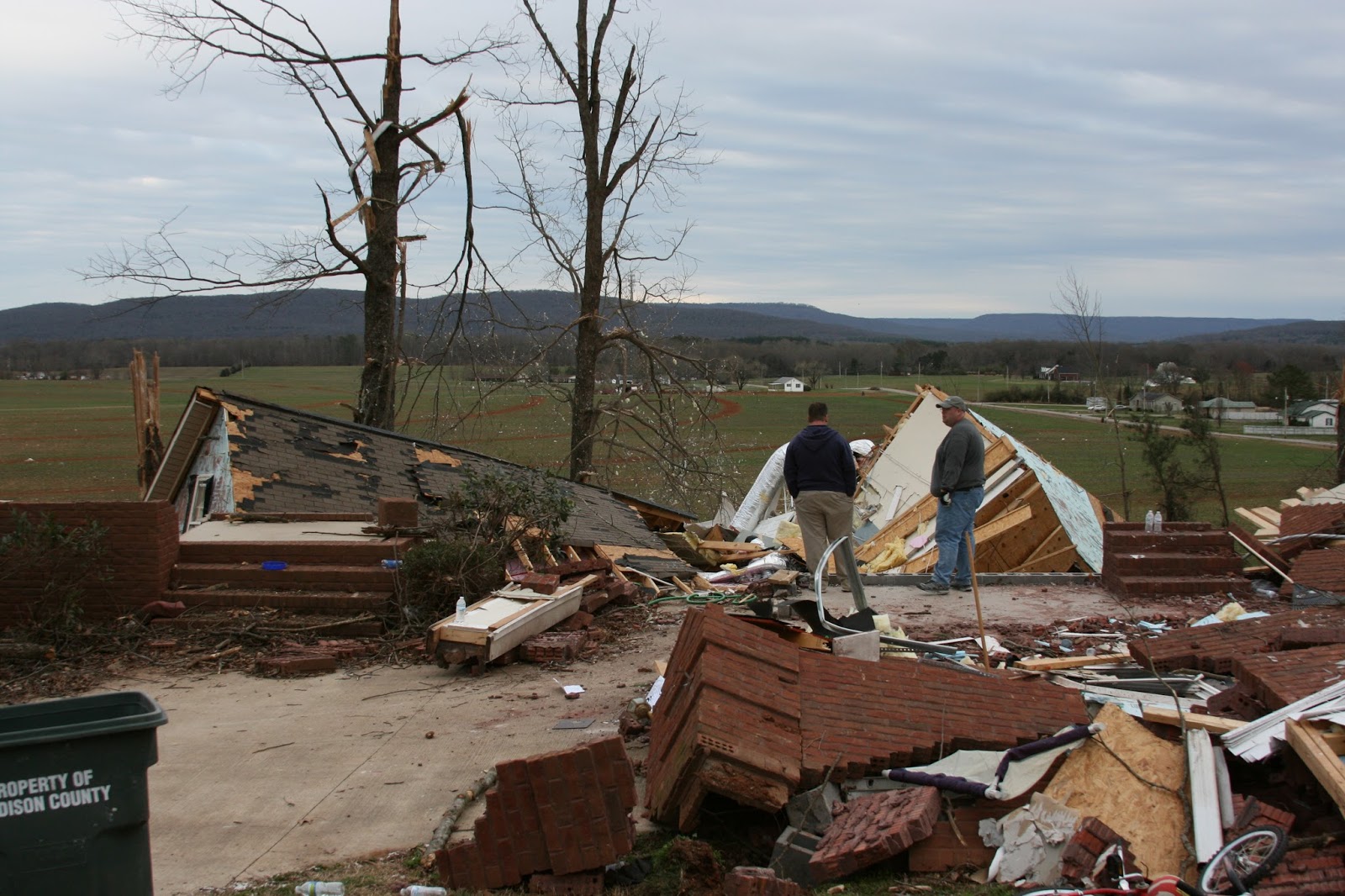

Standing over the rubble, I remember feeling strangely calm. Perhaps it was some level of shock, evidenced by the fact that in my report to my wife, I kept saying "the house was completely gone", creating a false picture. In fact, we salvaged a good deal more than I would ever have expected, looking at the destruction. But in a larger sense, I also knew that my Father in Heaven had a very tight hold on me right in that moment. For I knew, even in the moment, that it was just a house. My treasures, the people I love more than anyone in the world, were alive and safe. Ours was the only house in the neighborhood that was destroyed, and no one was home when it happened. Many of my neighbors were taking cover inside their homes when the tornado came through, and every one of them was safe. We had lost nothing that could not be replaced, and we would recover.

For the next week, it was a massive salvage operation. Slowly and steadily, we picked through every corner of the pile, pulling books, computers, files, and more. We found clothes and pictures, covered in drywall dust and insulation, but salvageable. We climbed through the collapsed kitchen to retrieve whatever wasn’t broken (excepting a memorable moment of fatalistic whimsy, in which my brother-in-law and I took turns hurling a set of old Corelle dishes down the hill like Frisbees). We rented storage units and filled them to the brim (in the end, even most of this would be hauled to the dump). We rented a house, and did everything possible to keep the boys in a normal routine (they did not miss any school). We were surrounded by people - family, friends from work, church, school, Scouts, and more, all of whom came alongside us in those first weeks. That memory, being the recipient of such great grace, is one memory I will always, always treasure. In fact, I want to be sure that if I hold on to anything, it is that experience of God's loving hand through the kindnesses of others.

That isn't to say it wasn't difficult or draining. Once we had picked through everything, it was time to clear the property. I remember well dealing with the emotional emptiness that people say so often follows traumatic experiences. Some days, it was very hard to soldier through. But we weren't really alone, no matter how we felt sometimes, and we did come through it.


I could go on, I suppose. But I am mindful that this was supposed to be a quick look back. With that, and knowing that I have chronicled our experiences with this storm and others before on this blog, and I suppose it would probably just be easier to point you, the reader, to these posts to read at your leisure. So let me list them here, after which I'll get on with my closing thoughts.
"When the Lights Can't Come Back On"
"One Year Later, Or Last Month"
"The Future Remains Unwritten"
"One Year"

The Rebuild Process (Chase Manor 2.0)
There's more of course, just scan any of my posts March - August 2012. But moving on now, to the present. Nearly four years have passed since we moved into the rebuild. It was certainly disorienting at first, and even a year after moving in, it was weird. Today, I still catch myself looking in cabinets for things that we no longer have, or looking for them in places where they would have been in the old house, instead of where they are now. Fortunately, this is happening less often, but it still happens. It is the ultimate cliché, I know, but life really has moved on. The boys are older and thriving. We are older, working as hard as ever for our respective employers, going to church, and simply trying to keep up with the pace of life. I walk around the house and the yard, and as always, marvel at the number of projects still on my to-do list. The scars from the storm still mark our property, and to an extent our hearts. But they are healing, and they are not holding us back in any way.

Yes, we lost much. But 5 years later, there is no question in my mind: we have gained more. The worst did not happen, and to compare our experience with those who have lost so much more than a house would be a grave disservice. To this day, I remain humbled by the grace and mercy that has been extended to me and my family by my Father in Heaven. And if ever I should fail to remember this, I merely have to walk outside and turn my eyes to the east, to the rising sun. I testify to this simple truth: if not for the storm, I would not have the view I have today - literally, and spiritually. His mercies are truly new, every morning.
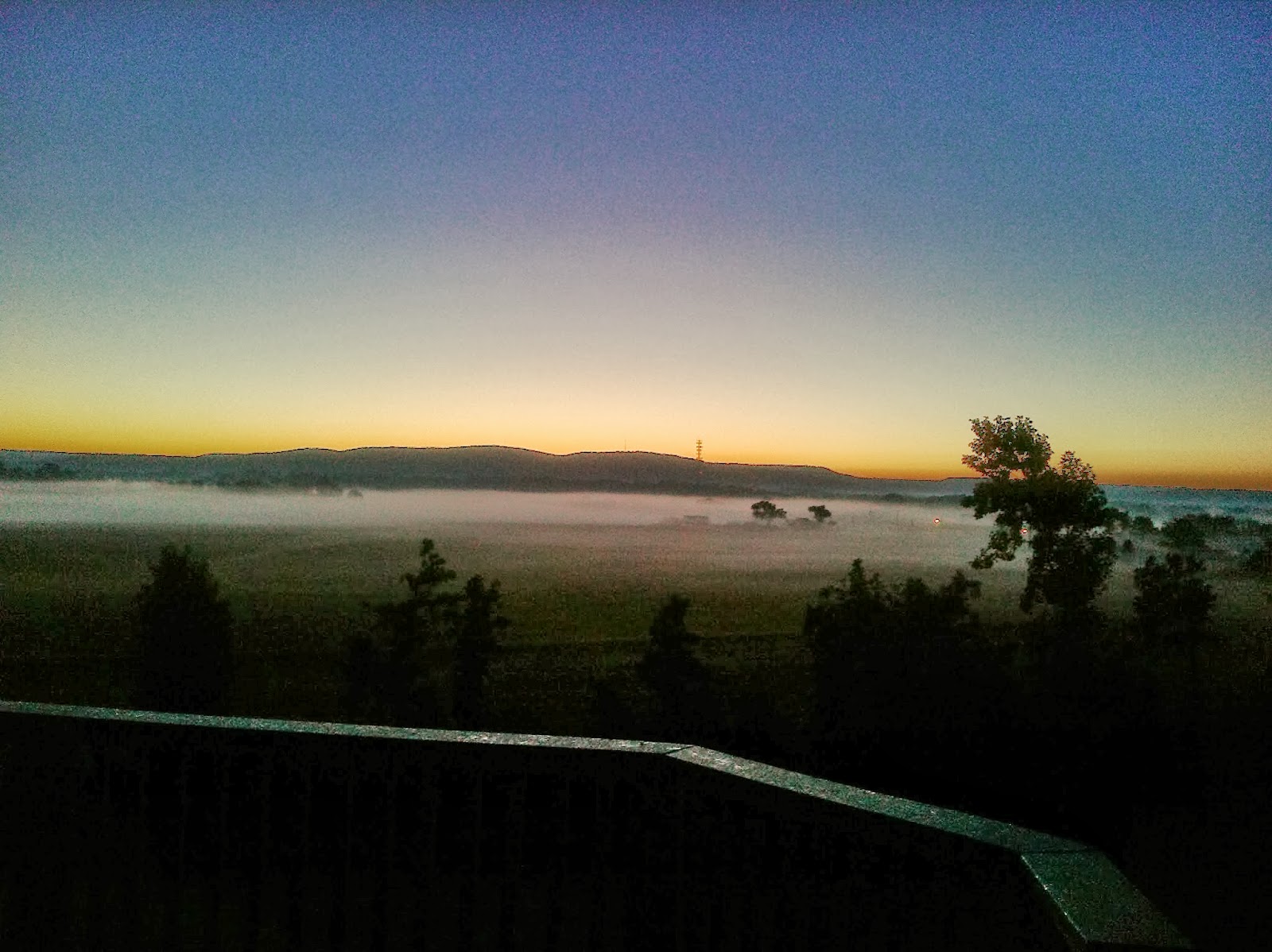


Five years. The more I dwell, the more I remember. But - and I cannot say this enough – I will (and must) be intentional about remembering the love and the grace we have received, and that we experience to this day. And most of all, I choose to look forward to the new day, where hope rises and affords the possibility of joy, of new life, of new dreams. For there is still more life ahead to be lived and to be embraced, whatever may come.

February 07, 2017

It's All Part of the Process

Quietly, the sun rises over the eastern horizon,
The cold dark expanse advances and recedes
Along the mist covered sands.
Off in the distance
Seabirds cry out
As they begin their morning hunt.
The ocean breeze carries their sound to me,
And makes me shiver.
I stand there, alone in my thoughts
Trying to shake off the effects
Of another sleepless night,
Trying to capture that new,
Waking feeling that comes with
Each new day.

Trying, yet in vain,
For the feeling once again,

… eludes me.
I wrote the poem above almost 29 years ago, as a teenager feeling a little lost in the world. I have often observed that I have an old soul laced with melancholy, and looking back on those words I find it hard to deny. And here I am, all these years later, with a penchant for watching the sun rise over the hills and fields behind my house, feeling almost exactly the same way. I have so many wonderful blessings I can count: a loving, stable family, a nice home, a good church, and a job that while consuming enables me to take care of my family. We've had our share of troubles: loss of home, car accidents, health scares, but we've managed to do okay through it all. I really have absolutely nothing to complain about. I have been most fortunate.

And yet.

I watch the sun come up in all its glory, with a light breeze inviting the steam from my coffee to spiral away, and in the undeniably peaceful moment, I still find myself feeling a little lost in the world. I'm not certain where I'm headed, if in fact I am heading any particular direction. I've never been an overly driven person, and have only fleeting experiences with the kind of passion that motivates one to go beyond and immerse themselves into any particular thing. Hobbies? No, not really. Just haven't really found one that energizes me in any particular way.

None of this is uncommon to a man my age, I know this. Yet that knowledge does little to assuage the disorientation I feel at certain times. In Philippians 4:12-13, the Apostle Paul speaks of contentment, and the truth that such peace can be found in any circumstances through Jesus Christ. I've known contentment, even in some very hard circumstances. Being content, of course, is a state of the mind, a state of the heart. As such, that sense of contentment is subject to the meanderings of mood and the fickleness of feelings. But this idea of contentment has a cousin: the concept of fulfillment. Scriptures are a little less clear on the matter of fulfillment. But as illustrated by James 1:2-4, one can infer that fulfillment (becoming "mature and complete, lacking in nothing") is in fact a process. We all yearn to be "whole", and we are all at times very painfully aware that we are not. Oh sure, we get glimpses from that mountain top now and then, but it doesn't take much for that sense of incompleteness to reassert itself. I can only conclude that fulfillment, being a process, is an achievement that may be realized only after a lifelong pursuit. There will always be some part of me not yet complete, not quite whole - until the day comes when all things are completed, when all things are made whole.

The above can be summed up as simply as this: Contentment is a state; fulfillment is a process. The challenge: somehow being content within that process.

If any of this makes sense, and if any of it is true, where does that leave me? My coffee cup is empty, and the day still beckons. I still feel a little lost. I suppose I can rationalize it this way: it is okay to feel what I feel, because feelings are transitory and are a natural part of life. The key is to press on, remembering that fulfillment is possible. It just may take a while. And that allows me to be content in the hope that for those moments when I feel a little lost, they won't last. It's all a part of the process.

May 25, 2016

Bison's Eye

Sometimes, you just have to get away. And not on some random airline. I'm talking about a good old fashioned, back of the station wagon kind of road trip. A good family vacation of this sort always produces stories that you can tell for years, or at least it should. Not wanting my kids to miss out on such an experience, last summer we loaded up the van and set forth on that utterly quintessential, cross-country family trip to the Grand Canyon. Holiday Road, anyone?

Long road trips are cathartic for me, especially if I'm driving. I am content to drive for hours in relative silence. While the occasional interlude of music or podcast isn't always unwelcome stimulation, I generally don't find it a necessity. Driving gives me time to process the perpetual jumble of thoughts inside my head. And this particular trip featured quite the collection of jumbled thoughts, as I was wrestling with the doubts not uncommon to a man in his mid-forties. Nothing dramatic, mind you, but the reevaluation of life's general trajectory at the proverbial half-way point seems to have become a frequent preoccupation of mine. After the first two days, I was feeling much better, much more settled in my spirit. But I digress.

The afternoon of the third day found us turning north on Hwy 89 from Flagstaff. The haze was heavy, muting the already earthen desert colors, but I was reveling in the alien landscape nonetheless. We came upon stretches of construction featuring one-lane alternating traffic that for the most part were tolerable, except for one where we found ourselves caught in a sudden, violent dust storm. I suppose there was a thunderstorm nearby, but we saw little rain from it. All traffic was stopped in both directions. As with any storm, sometimes you just have to wait it out until it passes. It always does.

From there, we swung over to 89A, filled up at Marble Canyon, rode along the base of the Vermillion Cliffs, and finally turned south on 67 across the Kaibab Plateau en route to the North Rim. The transformation of the landscape was startling, going from desert and haze to forest and blue sky in the late afternoon sun. Small meadows opened up on either side of the road. It was wonderfully picturesque, and my word don't do it justice. But my momentary reverie was about to be disrupted in a most startling way.

We were on approach to the small gatehouse marking the entrance to the North Rim, when I noticed a line of cars stopped in the opposing lane several hundred yards outside the park entrance. Further left, in an area of shallow meadow, was a herd of bison, about 30-head. That these people were stopped in the road alongside a herd of bison seemed to this traveler as not a wise thing to be doing. And then it happened.

As the gap closed between me and the line of paralyzed onlookers, from the herd came a beast, massive in size, with menace in his manner. He bounded along a path parallel to the road, and with a swiftness that defied his mass, turned toward us with head lowered, his visible eye wide and blazing. Like a movie cut in high definition clarity, slowed to half speed, I hit the brakes. Loose items suspended about me in mid-air, slave to Newton's equations, and slowly flew to the front of the cabin - GPS, phones, cups, snacks, and other various clutter that collects on a long cross-country family trip. But the van responded, nose dipped, and through a windshield that seemed much too close to my face, I watched as the beast passed mere meters in front of me, such that I could see the powerful flank rippling and glistening with sweat. And above all, the eye of my adversary glowering with an unveiled hostility. And then he was across the road, to my right. To my left, the standing line of onlookers, still not moving, jaws dropped in almost witless expressions and still clearly unaware of their imminent danger. As for me, I shifted my foot immediately from the brake to the accelerator, gently but deliberately leaving the scene lest the creature decide to take another shot at this mechanical beast that so threatened his herd. And in those moments after, as the passage of time returned to normal, as my pulse slowed and the nerve endings along my spine ceased to tingle, I could only express: Did that just happen? Did that really just happen? Even now, I can still remember with perfect clarity my close encounter with that thunderous beast. And his defiant, unforgiving eye.

In the year since these events, I have pondered and probed this experience for some deeper meaning, a way to turn what is merely a fun and thrilling tale into some sort of metaphor or allegory that illuminates some portion of this absurd existence. Alas, I have nothing. Nothing that isn't already painfully, ridiculously obvious. News flash: Bison are not tame, they are not cattle. They are fierce, powerful beasts that are highly protective of their herd, and will not shy from attacking anything or anyone they perceive to be a threat.

I have only this: A bison charging across the road always has the right of way. Always.

Words to live by, don't you think?

March 30, 2016

Thoughts in the Aftermath of a Silly Online Quiz

Some months ago, in a moment of weakness, I succumbed to the most frivolous of digital temptations: a silly online "quiz." No, this was not some examination designed to test my knowledge of world geography, or to measure my understanding of obscure facts in the Star Wars universe. Rather, this quiz purported to reveal secrets about the nature of my personality based solely on - wait for it - what shapes most appeal to me. I've seen different versions of this from various team building seminars, but this particular one appeared to be even less scientific (if that is possible). There were some 20 questions, almost all of which asked me to select an image from a group that most appealed to me. I know you are anxiously awaiting the big reveal, so here it is (in part):
You are most often drawn to shapes that include rectangles, and this makes you the Explorer. You seek adventure and new experiences, and yet sometimes lack the funds or guts to make it happen. You are inquisitive by nature, and courageous too. You are naturally supportive of your loved ones and have tremendous strength and foresight. For those of you that take the risk, and go forth and travel, you love to get to know other cultures and people on your journeys. Explorers have a passion for knowledge, and like to converse with people from all walks of life. You seek harmony and balance in your endeavors, and thrive most when you are able to juggle risk and reward to your benefit. Curious, dependable, determined, and spirited, that is you.
Ah, behold the revelation of my true self, exposed by the selection of images that contain rectangles, above those with squares, circles, triangles, and abstract mishmashes of shapeless colors. Look at me, the Explorer! I am sure that when people see me, or think of me, "Explorer" is naturally the very first thing that comes to mind. Yeah.

Silly online quiz … probably exists only to collect personal data in some way to further enhance or exploit my "digital footprint" to the benefit of somebody else, or to sell me hiking boots.

But I must admit, these results have made me think. My 45th birthday is mere months away, and I have been pondering what to do differently, if anything, with the second half of my life. I've considered going back to school for a Master's degree, as well as the possibility of a career change, but have come to the initial conclusion that right now, I have neither the funds nor the guts to pursue either. In the near term, I'll probably have to settle for picking up a new hobby. Writing online quizzes, for example.

I do wish, sometimes, that I was that Explorer. I was as a child, at least in my imagination. Those days are mostly gone now. But the idea still flickers, deep down, I think, for whenever I give in to this navel-gazing introspection, a snippet of an old John Denver song plays in my mind:
Come dance with the west wind and touch on the mountain tops.
Sail o'er the canyons and up to the stars.
And reach for the heavens and hope for the future
and all that we can be, and not what we are.
I suppose, this is one facet of being an Explorer: reaching for Heaven, hoping for the Future, and looking toward all that we can be, and not just what we are today. I cannot begin to explain how this one verse in an old song speaks to me. Maybe, just maybe, it is confirming that long buried idea that I really can be more like this Explorer character.

Or maybe it just means I like rectangles.


March 25, 2016

Review: The Killing of History

For the past many decades, even the casual observer cannot help but to see that any activity, approach, or viewpoint that takes on (or has forced upon it) the descriptor of "traditional" is increasingly portrayed in a negative light. The arguments over traditional vs. contemporary (modernism, postmodernism, relativism) play out in almost every venue imaginable, most notably in academia, religion, and politics. Keith Windschuttle's The Killing of History: How Literary Critics and Social Theorists are Murdering Our Past pulls back the curtain on one such pitched battle in the field of historical studies. For the layman who may be largely unexposed to the various positions, theories, and methodologies at play, this book is a difficult read, and will take additional effort and self-directed research to properly interpret and absorb. While Mr. Windschuttle does offer definition, description, and context in his presentation of the issues that form the basis of the argument, what is offered presumes a certain level of preexisting knowledge of the subject matter and the debate.

From the opening pages of Mr. Windschuttle's treatise, it quickly becomes apparent that his work is not so much an intent to introduce the layman to the ongoing philosophical battles surrounding the study of history and its methods, but rather it is in fact a series of salvos directed at proponents of more contemporary theories on the discipline. The layman is unlikely to be familiar with the works of Derrida, Foucault, and a host of other historical theorists, past and present, and so to a certain extent has to trust the author's presentation of their cases and viewpoints. Nevertheless, the reading is a worthwhile exercise, because in doing so one acquires a better understanding of the motivations and the deficiencies behind the movements and initiatives that do reach the public eye, particularly as it pertains to history curriculum in schools, the phenomenon of "cultural studies" as a substitute for the more traditional views identified with Western civilization, and so forth.

As one reads the final chapter and closes the book, the reader cannot help but to sense that an important opportunity has been missed. For while Mr. Windschuttle's aim is to expose as illogical and unsupportable the theories of history that cannot be supported by empirical evidence, his defense of traditional methods of historical study is often limited to the contrast he presents against the ideas and theories he opposes. In other words, he fails to make a strong final case in favor of the traditional model of historical study. This is unfortunate, because he has a case to make. The reader would have been better served if the author had provided a conclusive retrospective that summarized the supremacy of his preferred methodology, instead of a two or three paragraph write-off to close the work. As a result, one is left with the impression that the book is more of a broadside against the ideas he opposes, and less a defense of the ideas for which he advocates. There is fantastic research here, and worth additional study. But it could have been more.

March 01, 2016

I Will Vote for Whomever I Please, Thank You

Ah, election season. A time for advocates of all stripes to proclaim to one and all why their candidate is the best, last hope in saving this great nation. A time for desperate pleas to join the cause, to stay loyal to the movement, to place my trust in the one who pledges to “take on Washington” and all its corruption. A time to bet on the horses, because really, all that matters is winning, about keeping the lesser beasts from ruining our country.

Advocates are passionate for their preferred candidates, and so they should be. I can stomach most arguments on behalf of any candidate, because such arguments all take on the same form, once you step back and examine them. For any given candidate, the advocate lauds notable characteristics and policy positions while simultaneously dismissing any flaws, all the while augmenting the flaws and downplaying any notable characteristics or positions of another candidate. More simply, it is the parable of the beam and the mote. The politics of destruction is powerful temptation, even among members of the same “team.” Again, this is the established pattern, and by and large I can entertain such arguments, and on occasion even be entertained by them.

What I cannot stomach, however, is the following argument that I see thrown out from time to time, even from friends: “A Vote for Candidate A is really a Vote for Candidate F.” I find such approaches to be unpersuasive at best, insulting at worst. I find it to be both the weakest and most desperate of arguments, logically and factually incorrect on its face.

With every choice, there are consequences. When I cast my vote, I may pick a loser, but in no way can you logically extrapolate that unfortunate result into a plus for the winner. It may seem a “waste” to supporters of another candidate, and they are entitled to that view. Nevertheless, my ballot will lie in the stack of whomever I choose, and only in his stack.

I have the fortunate privilege and responsibility to vote, and I take it seriously. I will vote for the candidate that best fits my view and my values. Absent such a candidate, I reserve the right to make a third choice and not cast a vote for that office. This is a choice I make, and that choice is an extension of what I believe and what I think. No more, no less. I don’t make such choices lightly, and I will never in good conscience vote for any candidate that I don’t consider as sufficiently worthy of my vote. Results may vary, but by and large I hold this to be true. Rest assured, I would no more vote for a tyrant than I would vote for a criminal.

I hold allegiance only to God and Country, not to party, not to any interests but those that align to my views and my values. It is my right, my freedom, my integrity, and my decision.

So, please, spare me such a specious argument as “A Vote for A is really a Vote for F“. I will vote for whomever I please, and if in the end my vote doesn’t matter, or doesn’t make anyone else happy, so be it. But nevertheless, my vote will count, and I will gladly stand to be counted, win or lose.

December 12, 2015

The Great White-Out of Midway High

What you are about to read is true.  Well, as true as the passage of 30 years will allow, given that time tends to muddy the recollection. Still, the story I am about to share remains a fixed part of my personal oral history, embellished only where necessary to enhance the tale and its telling. 
 
In the vast flatness spanning the horizon west of Grand Forks, one will find dozens of small, largely unincorporated communities with names like Mekinock, Gilby, Inkster, Johnstown, Honeyford, and Forest River. The first of these, where I lived for a time, rested 5 miles north of the runways of Grand Forks AFB, where on any given day B-52 heavies would fly directly overhead, mere hundreds of feet overhead, on their way to who knows where. Some of those flights featured crews that included my dad, but I digress.
 
On a lonely county road, in the relative center of all these townships, is Midway Public School. In my day, Midway was a K-12 facility, with only enough students to fill a single class for each grade. Indeed, had I stayed there through all of my high school years, I would have been in a graduation class of about 29. If I had to guess, I’d wager that this remains more or less the case to this day. The school features a hexagon pod for 1st-6th, and a couple of hallways for grades 7-12. We had a gym, of course, a real “shop” for woodworking, welding, and the like, and a big, curtained stage (part of the gym) where the pep band would stand and play for basketball games. From my home, the bus ride to and from school was 30 minutes – and I was the last pickup in the morning, and the first drop off in the afternoon. In my mind’s eye, I can still see it all – the gravel roads, the grain elevators, the unending flatness of the fields – as if it were yesterday.
 
Winters in this part of the country are marked by three things: frigid cold, bitter, howling wind, and drifts upon drifts of snow. Weather systems often drop out of Canada with frightening speed, bringing subzero temps, winds 40-50 miles per hour and even more, inches upon inches of snow, and drifts several feet high across the roads. This is a tale of one such storm.
 
I was sitting in class late one afternoon, English class I think, listening to the teacher drone on about something I don’t recall. To my left was a bank of windows that looked out to the parking lot in front of the school. It was an overcast day, but not unpleasant as far as that goes. As the clock turned slowly on its dial, it began to get darker, but there wasn’t anything unusual about that at that time of day, that time of year. Snow began to fall, and the wind started picking up, but again, nothing out of the ordinary for the northern Dakota plains.
 
Then it hit – a wall of wind and snow that shook the windows so hard that even the teacher was momentarily startled out of her monologue. We all stared at the window, chattering and marveling at what we were seeing. Or rather, not seeing. For where moments before you could see cars a mere 10-15 yards away, now was a wall of white. We’d had such conditions before, but usually they were relatively short-lived, and often looked worse than they really were (a good wind on a bright sunny day can grab the snow and blow it against the windows, creating a similar effect). This time, however, we were dealing with the real thing.
 
It wasn’t long before the principal came on the PA, announcing to the school that busing was being suspended due to the increasingly hazardous conditions. What with the wind and zero visibility, that was kind of a no-brainer. Students were to go on to their last period classes and wait for further instructions. The bell rang, and we went on, but with the buzz of adrenaline and excitement that comes with the knowledge that we were in the middle of something quite outside our normal routine.
 
By 3:00, the wind and the snow had only gotten worse. Some brave parents (or stupid, as the case may be) ventured out to the school to pick up their kids. But the vast majority of students like myself, dependent on the buses, were stuck. The principal came on the PA again, to announce that due to the worsening conditions of the storm, all students and teachers were to proceed back to their 1st period classes, where we were to in effect start a “new day” of school, regular schedule. Attendance would be taken. “Lunch” would in fact hit right about dinner time.
 
And so we did. Most teachers turned their class periods into a study hall of sorts, allowing us to complete the assigned homework from earlier in the day. One or two of mine continued with the next day’s lesson plan. Actually, it was quite ingenious, because it kept us busy (and contained) for as long as possible. Outside, darkness fell, the wind howled, and the white-out continued. Dinner consisted of grilled cheese, some kind of soup, and that chocolate cake mix the kitchen staff insisted was “pudding”. By the end of our second rotation through the school day, it was clear that we were headed into uncharted territory: they were keeping us overnight.
 
And then the party started. The gym was opened up, initially half-court for volleyball, half-court for basketball. Later, the volleyball nets were pushed to the side, to accommodate even more basketball. The pick-up games went on all night – and I do mean all night. Some classrooms that had AV equipment (TV/VCR on rolling carts) had movies, but I don’t recall too many showing much interest in that. One room had a computer, a TRS-80 maybe, that had one popular, hand-jammed BASIC game: Mow the Lawn. A few others may have worked on projects in the shop. But most of us wandered around, doing a little bit of everything, making the most of the freedom that came with having the run of the school. Teachers tried to chaperone, of course, but on the whole, given that there were fewer than 200 of us at most, things didn’t get too bad. The parents need not have worried about those poor kids stuck overnight at school; hanging out all night with friends, making the most of what was probably a bad situation, we were having a ball. A few people eventually did try to find quiet corners to sleep, but truth be told, not many of us really tried. At one point during the night, a couple of us went down the hall to the elementary pod to check on siblings. Most of these young ones had curled up to sleep in various places on the floor. I have no idea what else these teachers did to keep order down there, but I am certain they had their hands full.
 
By 2 a.m., the storm had finally passed, even clearing enough to allow the brilliant white moon to be seen shining overhead. Word got around that buses would roll at 7 a.m., as soon as the plows had cleared the worst off the roads. School was off the next day, of course. Sure enough, the sun came up on another frigidly cold morning. We loaded the buses and made our way home. And promptly went to bed. Well, at least I did.
 
Having lived in the South since the summer of ’86, I’ve seen what passes for winter weather here. Some years feature actual snowfall, a bit of ice, and the general disruption of life in a place ill-equipped to handle such things. And each time winter pays us a visit, I cannot help but to recall, retell, and romanticize the story I’ve come to call “The Great White-Out of Midway High”. For the better part of 24 hours, it was winter at its worst, but through the eyes of youth – the time of our lives, and a memory for a lifetime.

September 08, 2015

It's September, and that Means Sunrises

Of course, the sun rises everyday. And yes, the approach of dawn can be beautiful any time of year, if the conditions are just right. For the past few years however, it seems that September is the prime month for the kind of sunrises that reach beyond the barriers I so carefully erect, filling my eyes with colors and sometimes tears. I age with the seasons, and perhaps it truly is for such a time as this, when my reserves are low and I ache for renewal, that these masterpieces of divine tapestry arrive in quiet splendor.

His mercies are indeed new every morning.

August 07, 2015

Random MishMash

I'm not writing much these days, as should be quite apparent by now. There are many reasons for this, many having to do with the notion that "discretion is the better part of valor," which to take the true Shakespearean meaning serves as an indictment against the type of man I think I claim to be. I could say I am busy, which would also be true, but even this does not tell the whole story. I could say I am concerned with the Orwellian trends in our discourse, and that some exercise of caution may be warranted, particularly with respect to future employment given the public nature of our social media, blogs, and the like.

Needless to say, I've been doing some soul searching as to what I should be writing about, what I want to write about, and whether there is much to be gained by writing at all. (Hey, if I'm going to have a crisis of faith, better that it involves something like this than anything else more important!)

Below are a couple of nuggets, bite-size rants if you will, that are standalone thoughts I've jotted down or copied off over the last month or so, but never developed into anything more meaningful. They are generally devoid of context, so I'll leave it to your imagination what drove me to put them down.

  • I am forever amazed at those who believe progress means nullifying history rather than learning from it, and each other. And yet I shouldn't be, for this is a tale as old as civilization itself.
  • Willful blindness and the inability to accept the humanity and fallibility of our forebears for what they are makes my head explode.

Key quotes:
"Everything is permissible"--but not everything is beneficial. "Everything is permissible"--but not everything is constructive. - 1 Corinthians 10:23
“For under the smooth legal surface of our society there are already moving very lawless things. We are always near the breaking-point when we care only for what is legal and nothing for what is lawful. Unless we have a moral principle about such delicate matters as marriage and murder, the whole world will become a welter of exceptions with no rules. There will be so many hard cases that everything will go soft.”- G. K. Chesterton

And finally:
  • If a fool happens to speak the truth, that a fool said it makes it no less the truth.
  • Truth is more about what is, and less about what you think it is, or even who said it. Objective truth matters.

I also have a story about a bison, that perhaps one day I will put to print. I've started the composition several times, but end up marveling at the idea that perhaps I am more like the bison than I would have ever imagined. When I get that figured out, I'll have a story worth telling.